Monday, February 20, 2012

Some thoughts on war with Iran illuminated by Persian Incursion

War talk is in the air again, in the wake of a New York Times article this weekend suggesting that Israel may have already decided on making a strike by April.

There's a lot of speculation in the article and on the Internet about whether Israel could pull it off, and the headline of the article even suggests it might be difficult to do.

"Iran Raid Seen as a Huge Task for Israeli Jets"


It says.

Right.

As it turns out, of course, this question has been exhaustively examined in the Clash of Arms wargame Persian Incursion. I had hoped to write up a detailed review and session report based on an online game I had been playing, but real-life interruptions broke up the pace and its unclear whether it will get finished soon or ever. But I did play enough of it to get a good appreciation of the game's ability to address the question: Can Israel do it?

Let me address right off the protest: "But it's only a game!" True, but many experts familiar with both classified military wargames and civilian wargames have said that the military games have little or no advantages in accuracy over thoroughly researched open-source commercial games.

First off, it's important to note that Persian Incursion is really two games in one. The first is a political-diplomatic card game that can be played concurrently or prior to the military game and examines the complex interplay of politics, diplomacy, media, public opinion and other "soft" factors tat are critically important but hard to quantify. This portion of the game is highly subjective and not coincidentally provides the Iranian player with his best chance for successes. This is defensible from areal-world standpoint and, just as importantly, allows the game designer to create a competitive game experience for the Iranian side.

And the hard-data driven military game, which is basically a streamlined version of Larry Bond's super-detailed Harpoon4 game system, shows how necessary this card game option is because the Iranians, plainly have absolutely no chance militarily. Oh, sure, a lucky shot here or there may shoot down an Israeli jet or two or land an occasional missile in a Tel Aviv city block, with the consequent propaganda 'victory' for Iran, but the Iranians have no ability to impede the Israeli raiders in any significant military sense. Whatever the Israelis decide to destroy will be destroyed. The Israeli challenge is almost purely a technical and logistic one caused by the extreme distance and some limited resources. As such, however, it's also one that thorough planning by a highly professional military such as Israel's can be expected to overcome.

What the Israelis won't have to deal with is much of the way of unpredictably effective defensive action by the Iranian military. Their available aircraft and anti-aircraft missiles are several generations behind the Israeli attackers and, for the most part, will likely be completely neutralized. As I said, one can't completely discount a lucky shot, so there's some small risk for an unpleasant (for the Israeli side) incident or two, but losses will be minimal and damage extensive.

For the purposes of making the game competitive and challenging for the players, the game demands that the Israelis completely destroy their targets in order to get full credit towards winning the war. But in reality, all the Israelis have to do is destroy certain critical components of the targeted facilities -- whether nuclear or oil -- to accomplish their aim of delaying Iran's supposed nuclear ambitions. It's clear that they should have little trouble doing that.

In the final analysis, Bond's game suggests strongly that the military success of an Israeli strike is about as sure thing as you're likely to see in the annals of warfare. What the game does not -- and cannot -- answer is whether such a strike would be a political and diplomatic success or a disaster. The card game, however, does imply that's where the biggest danger for the Israelis and, by extension, the US lies.

Saturday, February 18, 2012

Session report for Revised War at Sea WAS-1 scenario

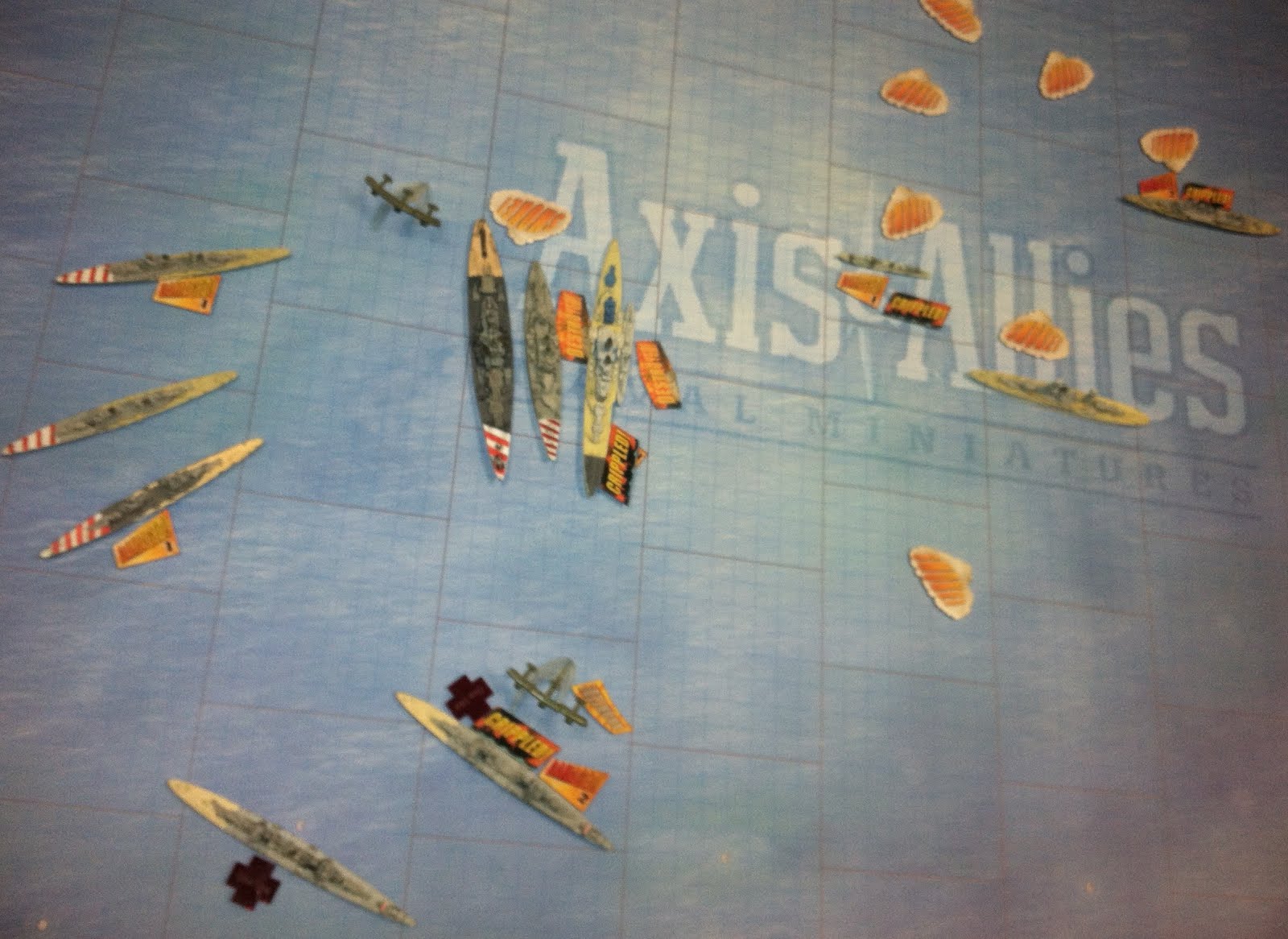
The peak of the action. Map and most of the markers are from Gale Force Nine, while the two red crosses are Litko markers showing that the ship's once-per-game special ability has been used.


Following up on this post, here's a resent session played at Arkham Asylum in Norwich CT. We had four players, so each player took one of the four task forces.

The pre-game die rolls were tough on bost side' destroyer forces. Iachino rolled a '5' and therefore had just two DD's while Campioni rolled a '6' and had just a single DD! The British hardly rolled better, rolling a five and therefore they were down three destroyers!

On the other hand, both sides were pretty fortunate with their reinforcement rolls. The British heavy ships showed up on Turn 3 while the Italian reinforcements arrived on turns 3 and 4. The Swordfish also made frequent appearances, missing just one or two possible turns. The Ark Royal must have been stationed just off the map edge.

The revised scenario seems a little tough for the British to me (as did the original version) but two solitiare playings did result in one British victpory on points, so it hardly seemed hopeless. There are a lot of random variables in the scenario, between destroyer rolls and reinforcement rolls, not to mention the air support rolls. It's also a very large scenario, with four capital ships, 11 cruisers and up to 20 destroyers.

One element that worked against the British was initiative, Despite having only a +1 edge on initiative rolls, the Italians won the initiative all but one time during the game.

Admiral Holland's cruiser force shaded to the north as it advanced, which Iachino's cruisers initially matched. Initial exchanges of fire were fairly even with the Italinas losing a destroyer and the Berwick being crippled and forced to fall back.

Somerville's capital ship/destroyer force soon arrived and started to close, although the Ramillies couldn't seem to make a speed roll (it failed every single one!) an was soon left behind.
Meanwhile Campini's force also arrived on the scene. Taking advantage of their initiative and spped special abilities the Italian cruisers swept south suddenly while the battle line headed straight at the British force. An awful turn of firing saw every single British cruiser miss its shots while the Italians sent two light cruisers t the bottom. This proved to be a major turning point, as it put the Itaians seriously ahead on points. Despite some clever maneuvering and efffective smoke screening by the British destroyers the Italians were able to capitalize on their firepower superiority to continue pounding the British while taking less damage in return.

With the "Limited Opportunity" die roll ending the game on Turn 7 the Italians pulled back to preserve their win. The Renown charged in to boarding range under a hail of Italian fire that left it crippled, but afloat, on the last turn. At point-blank range the Renown clobbered the Guilio Cesare and, with the assist of a DD-fired torpedo, sunk her!

This made the final score somewhat closer than it would have been, with the Italians scoring 112 points and the British 86. The sole survivors on the British side were the cripples Renown, Berwick and a destroyer -- and an unscathed Ramillies. One of the two swordfish also survived.

The Italians were in much better shape. The Vittorio Veneto and two heavy cruisers were undamaged, two cruisers had 1 point of damage and one cruiser was crippled.

While I think the scenario is more challenging for the British, it does appear they have a chance. Bad British luck during the first turn where both cruiser forces were blazing away at each other put them behind the power curve. The British commanders also didn't take advantage of the slight edge they had in reinforcement arrivals to draw the Italian cruisers out of supporting range of the battleships. With the aid of the smoke screening destroyers they could have arranged at least a one-turn firepower advantage. While called light cruisers, the British warships in Holland's task force are comparable in points, firepower and protection to Iachino's cruisers. Holland's task force is worth 63 points, rolls 31 dice at range 3 and all have armor 4 while Iachino's cruisers are worth 85 points, roll a total of 36 dice at range 3 and have armor values of 4 and 5. But add in Renown and the British have another 33 points of ship, with 11 more dice and an armor of 7. It's a fleeting potential edge, however, and in the event the British didn't achieve it.

Overall the revised scenario worked well. It's been suggested that the three Luca Tarigo's in the revised scenario should be replaced with more Ascari's to better reflect the historical OB but in this case so many DDs were removed by the pre-game die rolls that none of the Luca Tarigo's appeared anyway, so it made no difference.

Game ending positions

Wednesday, February 8, 2012

Revised 6-set OB for WAS-1 Action Deferred scenario


Revised 6-set OB for WAS-1 Action Deferred scenario

Changes Bold

Italian

Admiral Campioni’s Task Force

Vittorio Veneto BB

Guillio Cesare BB

Luca Tarigo DD x3 (Freccia, Saetta, Dardo)

Ascari x 4 (Alpini, Granatiere, Fucilieri, Bersagliere)

Italian must split DD lost by scenario special rule evenly with odd number his choice)

Admiral Iachino’s Task Force

Bolzano CA x1

Gorizia CA x 1

Zara CA x 2 (Fiume & Pola)

Trento CA x 2 (also Trieste)

Ascari DD x1

Camicia Nere DD x6 (Carabiniere, Lanciere, Gioberti, Alfiere, Carducci, Oriani)

First 3 DD lost by scenario rule must be Camicia Nere, after that, Italian choice)

British


Admiral Somerville’s Task Force

HMS Repulse BC x 1 (Renown)

HMS Royal Oak BB x 1 (Ramillies)

St. Laurent DD x 5 (Encounter, Faulkner, Firedrake, Forester, Fury)

Vasilissa Olga DD x 4 ( Gallant, Greyhound, Griffin, Hereward)

All Allied DD have Lay Smoke SA; British must split DD lost by scenario special rule evenly with odd number his choice)

Admiral Hollands’ Task Force

HMS Kent CA x1 (Berwick)

HMS Sheffield CL x 3 (also Southampton & Newcastle)

HMS Belfast CL x 1 (Manchester)


British Carrier Support Group

Swordfish Mk. II x 2 (Special rule applies to both squadrons together, i.e. one shootdown or 12 DR affects both units)

Discussion

The official scenarios were published when War at Sea was brand new, as part of the marketing effort, Being so early, they required a crazy amount of proxie and some pretty extreme ones as well. A good example is this scenario, where, as originally published, the American battleship USS Tennessee stood in for the Guillio Casare! I’m not sure how many of these scenarios got played as written anyway because few people would have had the models required, such as FOUR Bolzanos (a rare) or up to 14 Luca Tarigo’s.

I thought it would be interesting to revisit and revise those scenarios now that we have six sets worth of units to choose from In the case of scenario WAS-1, The Battle of Cape Teulada we go from having just one actual ship and a couple of sister ships with all the rest proxies to having no fewer than seven named ships and all the others either sisters or near-sisters with no proxies required at all.

Notes and rationales

Vitttorio Veneto – no change

Guillio Cesare – we now have the actual ship, so it is used.

Luca Tarigo x 3 –can cut down on the number of Luca Tarigo’s now that we have Soldati-class DDs available.

Ascari x 4 – we substitute Ascarisfor the four Soldati-class DDs in Campioni’s task force

Blozano – We only need one now for the actual ship.

Gorizia – actual ship now available

Zara x2 – Two Zaras are used to represent sister ships Fiume and Pola

Trento x 2 – We have the actualship for the Trento and use another one for sister Trieste

Ascari -- we have the actual ship

Camicia Nere x 6 – I think it’s a bad idea to require inordinate numbers of particular model when sister ships are available. Here we substitute a half-dozen Camicia Nere for the other Soldati-class DD’s present. Due to the scenario special rule you’ll always lose at least one DD from each group, so you actually only need four Ascari and five Camicia Nere models in practice.

HMS Repulse – Substitute for sister ship Renown, and as everybody knows, the model is actually the Renown anyway, so we could consider this as having the Actual Ship.

HMS Royal Oak – Substitute for sister ship Ramillies.

St. Laurent x 5 – C class DD substitutes for near sister of the E and F classes)

Vasilissa Olga x 4 (Greek DD substitutes for near sisters of the G and H classes)

I added the Lay Smoke Screen SA as a special rule to keep an important tactic available to the British side that the Javelin DD’s had made possible.

HMS Kent – Substitute for sister ship Berwick

HMS Sheffield x 3 – One is the actual ship, with the other pair representing sisters Southampton and Newcastle.

HMS Belfast – Substitute for sister ship Manchester

Swordfish Mk. II x 2 – I doubled the number of Swordfish to make up for the increased point differential between the two sides cause by the various substitutions and also because the British carrier Ark Royal was the carrier present, not the Illustrious. Optionally you can add the Ark Royal and one more Swordfish to Admiral Somerville’s Task Force and skip the special rule, although I am not sure this helps the British overall.


Friday, February 3, 2012

1942: The Hinge of Fate

We're a month into 2012, and also a month into the 70th anniversary of 1942, probably the pivotal year of the entire war.

In Winston Churchill's epic 6-volume History of the Second World War, Vol. IV was called "The Hinge of Fate." It's also no coincidence that the classic version of the Axis & Allies war game is set in 1942, the moment when everything seemed to hang in the balance.

It's true that the seeds for ultimate victory and defeat were laid earlier -- but they always are, aren't they? But it';s also true that 1942 represented the point at which things could go either way. On the one hand, if the Axis could build on their 1941 successes in Russia, the U-Boat war, North Africa and the Pacific, ultimate victory was was in sight. On the other hand, if the Allies could stem Axis advances, there was every expectation that eventual victory was assured as their superior economic might came more and more into play.

Bataan, Malaya, Coral Sea, Midway, Guadalcanal, Stalingrad, Gazala, El Alamein, Operation Torch -- the year was full of dramatic developments but by the end of the year the Allies had succeeded in stopping the Axis advances and could start the slow process of rolling them back.

The battles of 1942 are very popular topics for wargames because of their inherent drama and because, I think, so many of the battles were pretty even. I'm going to try to note these as the anniversary dates approach -- and also 1862 for the Civil War 150th and try to get at least some commemorative games played.

Monday, January 30, 2012

Some Thoughts on War at Sea Special Abilities in the post-RB era

With the departure of lead designer Rich Baker from WOTC and the subsequent uncertainty about the future of War at Sea Axis & Allies Naval Miniatures, it's worth considering how fans of the game will cope with various issues related to the game.

One of those is what to do about the various ships that never appeared in the six sets that were published. While custom units have been a popular feature at Axis & Allies Fourmini all along, these were always 'unofficial' and subject to be superceded when the ship finally appeared in official form. The problem now is that there will be no 'official' versions of some ships, but it would be nice to have a consensus among the players on the accepted game stats for some of the ship's likely to appear, epecially given the Shapeways ability to make models compatible with WAS.

Generally the basic stats like speed, hull points and even firepower dice are not too controversial, but special abilities are another matter. They're improtant for giving the game it's flavor, but at the same time they can be highly subjective.

I think the current SA fall into three broad categories.

The first are the ones that are inherent abilities of a ship or weaposn system as will pretty much always appear when the ship's hardware warrants it. Some examples include the Long-Lance Torpedoes SA of most Japanese surface combatants, the Extended Range X SA of most battleships and the Submerged Shot SA for most submarines. These aren't so much "Special" abilities as they are standard abilities that just don't occur often enough to have a spot on every card. Most of these are pretty uncontroversial and if a ship has the hardware it gets the SA.

The second type of SA that is all-about giving a ship a unique flavore based on some unusual event in its history. Examples of this include the Fatal Flaw SA for HMS Hood, the Embark B-25 SA of the USS Hornet or the Inspiring Example SA of the USS Arizona and Giogios Averof. Often these SA aren't even much of an advantage and they are always highly subjective and often controversial. In my opinion these sorts of SA should probably be avoided in the future without RB's explicit endorsement. I think they'd likely be contentious when ap[lied, which defeats the purpose of having widely accepted semi-offfiical stats for new models.

The third type is, by far, the largest, and these are historically justified SA that are selectively applied to certain units -- generally for game balance and interest -- but are by no means exclusive to those units. A good example of this is the Lay Smoke Screen SA, which every destroyer is the game could legitimately have, but is limited to certain units. Other examples include Sub Hunter, Radar Fire Control and the various Expert plane SA that many aircraft carriers have. Most of the game's current SA fall into this group and it would be interesting to see where opinions fall on how often to include these for new models and if there are any criteria that should be applied.

Monday, January 23, 2012

The future of D&D and RPGs

And interesting article from an insider explaining why the RPG business is in trouble and some thoughts about where it may go from here.

Thursday, January 19, 2012

Mussolini as Schrödinger's cat

The Storch lands next to the hotel in preparation for evacuating Mussolini (represented by the German Victory Medal) under the protection of Otto Skorzeny (represented by the Green Battle Star counter). The landing site is well-guarded by German paratroopers, but note that each unit has lost a figure. At upper left is a unit of Italians (here depicted using Russian figures) trying to stop the evacuation.

Was he alive, or was he dead? It all depended upon when you looked, Thursday as Game Store Tony and I took a short break from our Russian Campaign to play a scenario from the new Memoir '44 Campaign Book 2, specifically the Rescue of Mussolini scenario from the Air Aces campaign.

I really wanted to try this one out because it's quite different from the typical Memoir '44 scenario. For one thing, victory is not based on medals -- but simply on Mussolini's fate. If he's rescued the Germans win, if not, they lose.

There are quite a few special rules and a chance to use pieces that don't see much use otherwise, such as the Storch liaison plane and paradrops.

The Italian force is comprised of eight regular infantry units deployed in four pairs across the hill and mountain hex adorned map. Mussolinui, himself, is represented by a German Objective marker in the Prison Camp Hex.

The German force is comprised of six elite infantry units which enter via the Paradrop procedure, which in Memoir '44 involves actually dropping the pieces from about a foot above the map! After they land the Germans can give a marker to one of the units representing the legendary German commando leader Otto Skorzeny. The fnal element of the German force is the Storch Liaison plane, which must be used to evacuate Mussolini.

On our first go around, the raid was pretty much a disaster. Two of the six German units were destroyed while landing and the others were scattered. While Skorzeny was able to lead two units in an assault on the prison that liberated Mussolini, the Italians seemed to have no shortage of useful cards, and were able to react energetically. A mad dash for some safe spot was unsuccessful and the Italians ended up mopping up the whole German force and recapturing Mussolini. The Storch was never brought on.

We set up and played again and this time it was the Germans who seemed to get most of the luck. Only one German unit was lost in landing and the three units in the eastern batch landed in a tight group near the hotel, as did one scattering unit from the western group. Skorzeny again led a charge on the hotel that liberated the deposed dictator but this time there were a bunch of supporting units along for the show. Meanwhile the Ilatlians had areal drought of usable cards, being stuck with several for a sector where they had no units.

The Storch was brought in, landed and took off with Mussolini for the win -- although possibly just in the nick of time, because the Italians had just drawn the Bombardment card, which Game Store Tony was clearly going to use on the grounded Storch if there had been another turn.

We agreed that we needed one more game to resolve the split, so we made plans to play a tie-breaker at the first opportunity!

Sunday, January 15, 2012

Arkham gaming


Had some nice gaming sessions at the opposite ends of the time spectrum at Arkham Asylum this weekend.

On the one hand there was a quick, 45- or 50-minute game of Memoir '44 on Friday where my Germans were able to make short work of a large force of Russians during our continuing grand campaign game. Even though Tony's Russians had son many troops they overlapped the enire baseline by two ove rand each side and had two more reinforcements the Germans were just hot on the dice and had pretty decent cards to back them up as they rolled to a 6-2 victory.

On the other hand all day Sunday was spent in a grand campaign of another sort as we played Axis & Allies 1940 Global rules using the Alpha +3 revisions. Three fellows from the Hartford group came down to play myself and Roy at Arkham. Two of the Hartford gamers played the Axis, with one controlling Italy and Germany and the other Japan. A Hartford colleague controlled the British and the French, Roy handled the Russians and I handled the USA, ANZAC and China.

To make a long story short, I think things went relatively satisfactory for the Soviets (Moscow was at least 2 turns away from falling when we ended on Turn 5), the ANZACs (Homeland safe, fleet just took Okinawa) USA (large fleet parked off Japan, troop convoys forming in USA, Philippines never fell) and China (Almost all territory liberated) but this didn;t make up for a series of disasters involving Britain. The British player was aware of the threat of a Germa
+n Sea Lion on Turn 3 but he forgot to move the destroyer he intended to sacrifice to block the North Sea approaches. This, of course, created a cascade of negative effects elsewhere, despite the fact that Britain recaptured London on the next turn. Perhaps the most damaging effect was that Italy was basically left alone to rampage throughout Africa and the Middle East. Italy's economy got up to 50 + bonuses and Italian troops were as far south as the Belgian Congo and as far east as Western India at game end! The Japanese essentially abandoned much in the way of effort against the US and China to concentrate on the British and managed to take India on Turn 5. This second blow caused the Allies to concede, as we judged this was not a recoverable situation. While the Soviets could hold out to turn 7 or maybe even 8, there was no prospect of relief for them even then and the German juggernaut was just gathering stean and had substantial Italian troops available for devastating one-two punches against Russia. I had some hope of the US and ANZAC taking Japan by turn 8 or 9, but this would have been far too late as the Germans were poised to take London AGAIN on turn 6. With the fall of Moscow (and necessarily the third Soviet city as well) the Axis would win a European victory on Turn 6, long before the US plans could bear fruit.

A sea of green US pieces surrounding Japan does no good as disasters elsewhere doom the Allies cause.

It was good playing against such experienced Axis players, however. I picked up a lot and have some ideas of what to do for next time. We were really hurt by the British error, which negated some pretty good play on the part of the Soviets. I didn't feel too bad about how I was doing but the problem for the US is that it's hard to start to have a game impact unless the Brits can hold out.

Overall, though, it was a good game. I don't know when we'll do another Arkham Global 1940, but we may make a trip up to the hartford group's "Bunker" this spring.

Monday, January 2, 2012

Off to a gamey start


Here's starting the new year off right -- the girls and I sit down for a game of Bosworth.

Monday, December 26, 2011

2011 gaming year in retrospect

Marengo scenario setup from Napoleon's War Volume II: The Gates of Moscow, one of my 2011 purchases.

2011 is almost over and what an unusual gaming year it was for me. The biggest development of the year was being laid off from my job. While having a considerable negative effect on my finances, perversely it was a boon gaming wise.

Nothing like having an awful of of time on your hands to inspire a lot of game-buying, and as near as I can tell I acquired about three dozen new games over the twelve months, about half new 2011 titles and the rest from previous years. In addition, I picked up expansions and bought a couple of cases worth of War at Sea naval miniatures as well. My back of the envelope calculations indicate this probably cost me somewhere around $1,800. Mitigating this shocking expense, however, was a very active year on eBay which grossed me around $1,900 from game and miniatures sales. After taking into account shipping costs and fees, the total out-of-pocket impact on my budget was just a few hundred dollars. More than half of the eBay income came from selling off two major collections (My TCS series games and my Lord of the Rings Tradeable Miniatures) which were painstakingly assembled over long periods of time and unlikely to be repeatable in 2012. As a result I'm going to have to severely curtail new game purchases -- at least until I find a job!

On the other hand, this was an exceptionally good playing year. This, again, was part of the fallout from losing my job. My biggest gaming constraint for years was the mismatch between my schedule and most potential opponents because I worked an evening shift. While I had most weekends off, they were so crowded with other life activities that my gaming opportunities were limited. Being laid off sure freed up my time! Also helping was getting involved in several local Meetup groups, being able to attend the Central Connecticut wargamers occasionally and a lot of activity at the local game shop Arkham Asyklum. All-in-all I played quite a few face-to-face games this year -- perhaps the most in decades.

As far as those acquisitions went, quite a few were continuations, expansions and sequels to various series I've enjoyed, such as Napoleon's War, Fluxx, Munchkin, Small World and Commands & Colors. There were also a fair number of notable new game such as Star Trek: Fleet Captains, Conquest of Nerath and Test of Fire.

Personally, my newest enthusiasm was for cooperative style games (and their semi-cooperative kin) represented by the Fly Frog Productions line of games such as Last Night on Earth and Fortune and Glory and similar tiles such as the Dungeons & Dragons adventuring games, Star Trek: Expeditions and Forbidden Island.

This also continued a trend towards lighter fare among my purchases. While I did pick up some hard-core simulations such as Persian Incursion and Lock n Load: Day of Heroes, the vast majority of the year's acquisitions were more along the lines of Test of Fire, Shenandoah and Napoleon's War -- definitely wargames, but not really simulations.

It's not hard to trace the origin of this trend -- it's just hard to get simulation games on the table. Opponents are scarce and time is precious these days for that sort of game, which tends to be time consuming -- and not just in table time. To get the most out of a good simulation game it really helps if both players are reasonably familiar with the game rules beforehand, which adds to the imnvestment in time compared to euro games and other lighter genres.

I've pretty much given up on worrying about it. While I occasionally break down and pick up an old school wargame such as Four Roads to Moscow, Falklands Showdown or Marengo: Morning Defeat, Afternoon Victory, I usually take a pass these days no matter how tempted I am. Every time I feel the urge I just ask myself the question: And just WHEN will that get played? Unless I can justify it despite the likely answer of "Never," I probably won't buy it.

Also helping me exercise some future purchasing discipline is the likely end of the line for my only active collectible game: Axis & Allies: War at Sea. While there's some slight glimmer of hope that another set may appear, it probably won't be in 2012. In any case, I won't start another collectible game. While I don't have the same heartburn many do about the limitations of the format, there is the serious problem of what happens when the game gets canceled. Experience has shown that even a very good game such as Dreamblade or Navia Dratp becomes almost impossible to get on the table once official support dries up. The Axis & Allies Miniatures (both land and sea) and the D&D miniatures lines have some utility outside of the official game rules, but the basic problem remains that the collectible format really relies on a stream of new material to work. Once the stream dries up the lake will inevitably dry up and vanish.

While I did acquire around three dozen games, which is a lot, the good news is that I had a very successful time getting the new games on the table -- playing at least 21 of them at least once. This is important because my experience has been that if I don't get a game played within the first year of owning it, there's a very good chance I'll never play it. Several of the not-played yet were late 2011 acquisitions such as Sheandoah, Merchants & Marauders and Julius Caesar which I fully expect to get played soon. Some others were solitaire or solitaire-capable games such as Hornet Leader: Carrier Air Operations and the D&D adventures games that I can always get around to playing someday. There's just a handful of games like When Lions Sailed and Four Roads to Moscow that have dubious prospects for future table time.

Job prospects for the coming year are hard to predict, but it seems very unlikely I'll ever work at a newspaper again, with the evening hours that usually requires, so I expect that I'll continue to see a fair opportunity for game playing in 2012. I expect game purchases to slow down a lot, though. I've already cut down on my pre-orders (just Commands & Colors titles and Wizard Kings expansions currently) and, as I said, I am done with collectible games. Or so I say. Time will tell!

Sunday, December 25, 2011

Rich Baker starts a blog

War at Sea designer Rich Baker has started a new blog which I'l be keeping a close eye on. With luck we will find out that War at Sea isn't quite dead yet.

Thursday, December 22, 2011

Took the new Crusader Rex out for a spin


Game Store Tony provided the willing Guinea Pig for a play through of the newest version of Crusader Rex. While he'd played block games before, he'd never played this game or its earlier versions. Your truly had played the earlier versions a couple of times, but this was the first outing for the new edition.

Overall, my impression of the new game is that it plays well and seems more strategic in a good sense. Now that most of the units can return if eliminated (only the military orders and Saladin's family are permanently dead) there's not the severe unit shortages that could occur in the old version.

Well, at least, there's not inherently unit shortages. In our particular game Tony's Crusaders lost two early battles with devastating losses and this put his side down for the count early. He made a valiant effort to come back and did manage to conquer Egypt briefly and dispatch two of Saladin's relatives, but before long the green blocks seemed to be everywhere. Frederick Barbarossa showed up, but we called the game before playing the final year because it was obvious the westerners had no hope of success. The Muslim's held six of the seven victory cities and were in enough strength up north that there was little chance of Barbarossa taking even one -- and every chance he might lose the one he guarded.

My aim is to get it back on the table in early 2012 and see how I cna do with the Outremers.

Sunday, December 18, 2011

Sticker Shock


No, not for the price (although at $59.99, $89.99 with a mounted map Shenandoah is a little on the pricey side), but for the new, tougher stickers that come with the game.

Fortunately Columbia took the precaution of including in the box a little note warning purchasers that they've switched to a new and stronger adhesive, but let me reinforce that warning. These are not your father's stickers any more. I've never had a lot of trouble with stickers coming off my earlier Columbia games with the exception of an old edition of Rommel in the Desert where it was a real problem, but it does happen occasionally. But I have seen complaints online so obviously it has been a problem, so it appears that Columbia has taken heed.

But take heed of their warning as well. You WILL need a razor or thin knife to take up the stickers neatly. Trying to peel them up with your fingers risks damage to the sticker edges. Likewise, take special care in applying the stickers because you will have a hard time repositioning a misapplied sticker without leaving some adhesive behind.

The need to apply stickers has always been one of the drawbacks for block games because it usually means you can't just play it out of the box (an issue at, for example, a convention) but the new adhesive will mean this is especially true. Columbia has been pretty good on customer service but I predict they will have to replace an unusually large number of sticker sheets for customers who end up damaging their stickers. As a matter of fact, it probably would have been a good idea to include a double set of the stickers to provide spares (much like GMT's practice)

Thursday, December 15, 2011

Very bad news for Axis & Allies and D&D fans

Lead D&D and A&A miniatures designer Rich Baker just posted that he's been let go from Wizards of the Coast!

This is, of course, awful personal news for him. Being laid off a week before Christmas sucks. Actually, speaking from experience, being laid off at any time sucks pretty bad, but the holidays is even worse.

It also throws the entire future of D&D and Axis & Allies miniatures products into doubt. WOTC has already indicated it was backing out of the painted miniature category. It appears that Pathfinder may have eaten in to D&D's market share a bit, but I'm inclined to think it's bigger than just one line's market share issues. I've suspected that the "Golden Era" of boxes full of plastic and painted collectible miniatures we have enjoyed over the last decade or so was an artifact of some temporary economic conditions (specifically the price differential between China and USA) and was coming to a close.

I'm not sure what WOTC's plans are for the D&D stuff. They were working on a new set of skirmish rules, but I don't know if that's going to see daylight now.

As far as the Axis & Allies miniatures line go, Baker said that his layoff did not mean any miniatures lines were being canceled and he seemed to offer some hope that he'd be able to work on some projects on a freelance basis. Realistically, I've thjought that the land miniatures line was all but certainly dead already and that the hoped-for Late War set was never happening. There was just too long a break since the last set and it would basically mean restarting the line. I also think Angels 20 (the new air game) is a dead duck. Whatever is already paid for in the pipeline will come out, but I doubt very much there's bee anything new started. I suppose there's a small bit of hope for a Set VII for War at Sea, but it's a slender one.

I think we can also lay to rest any thoughts of a reborn Heroscape. Among the other layoffs was the brand manager for the Avalon Hill and Axis & Allies lines, so even the future of the board games may now be in doubt. I know there was some talk about an exapnsion for Battle Cry and Larry Harris was working on a final set of rules for 1940 Global Axis & Allies. Without someone to guide these along I have my doubts. The sort of intensive attention wargames/RPGs need was never a good fit for Hasbro/WOTC anyway -- they're certainly no GMT!

Overall, a very sad day for fans of a number of popular games.

Wednesday, December 14, 2011

Lest you think I'm always a loser ... .


While I got my head handed to me at Piepsk earlier in the day, I was able to make agood showing in TWO games of Acquire that night, coming out on top in both four-player games. I've only played the game a few times before, but I am starting to get a feel for the strategy.

As a side note, there are some odd gaps in my game experience Acquire has been out for decades but I only recently started playing it -- which is too bad because it really is a great classic game.

Both game developed quite differently. The first game saw a large, dominant corporation quickly get safe status and take over half the board while the other corporations did what they could with the rest. One of the seven corporations never made it onto the board at all. I was able to win because I had acquired a good position in that dominating company early on and ended up being the majority shareholder and decent positions in many nof the others. Still, it was a close game and I only won by less than $2 grand.

The second game, in contrast, shown at top. was much more free wheeling with all seven corporations making early appearances. There were even a few times players would have like dto have started new corporations but there were none available. This game was a little more decisive, as I was more than $5,00 ahead of the next player.

I'm still learning this game, but it seems important to keep money flowing and try to be at least a participant in most of the corporations. A couple f the players found themselves cash poor because they were heavily invested in some safe corps and unable to generate funds to take advantage of opportunities as they appeared. Because of this I was able to get majority or minority shareholder bonuses on the cheap by having one of a handful of shares in taken-over corporations for a nice return on the money. In afour-player game having 8 or 9 shares was often enough to control a safe corporation and even a single share might turn a tidy profit when a small chain gets taken over if no one had the money to invest in it. I hope to get this on the table a few more times over the next few months.

The massacre at Piepsk

The Russians make an early move with some Berserkers.


Well, the scenraio is actually called The Hedgehog of Piepsk, which old school wargamers will recognize was the fourth scenario in the original Squad Leader.

I hauled out the old warhorse for some old school wargaming with Game Store Tony. I haven't played the scenario in 10 or 20 years, myself, so things were more even than they may appear, especially because one of Tony's more notable qualities is that he's a quick study.

I took the Germans in the interest of saving setup time, because I could plan a clever defense ahead of time. Well, I thought it was at least solid, if not clever. I placed four LMG-equipped squads in the four buildings in the center of town to form the main position. Covering the left flank was the MMG with a squad and 9-1 leader while the right flank was coverered by the HMG with a squad and the 9-2 leader. The 8-0 and radio were also posted on the left as the lines of sight seemed better. Finally the other 9-1 and two squads were posted in reserve behind the town in the center to react to the Soviet advance.

Tony's plan was a simple, wide front advance evenly spread around the board, with the LMGs, MMG and leaders seeded throughout the force.

Things got off to a decent start as the first few defensive fires from the German machine gun teams cut down Soviet stacks like wheat. A full dozen Soviet squads were KIA'd before the first German loss. I have to say, though, that I don't really like playing the Germans in SL because it seems like they're always relying on a few key units -- so long as they're doing their job the Germans are tough, but a moment of bad luck can be very costly. I actually prefer the Soviet and US forces which are more homogeneous.

Sure enough, a bad morale check on a fairly low odds attack cleared the left flank MMG and the Russians surged forward. Bad luck with the initial artillery placement and an ineffective FFE foiled my back up plan and the 8-0 was overrun.

After this point things went down hill as Tony was able to swarm the town. German ffire groups, even massive ones with 20+ FP were not able to finish off Soviet targets. Throw in some berserk Russians, some bloody close combats and the end came swiftly. The Germans losses in the second half of the game actually exceeded Soviet.

While I felt my battle plan had legitimate promise, the fact of the matter is that Tony wiped out the Gemran force to a man and captured all five buildings in just 8 turns of the 10-turn scenario -- not a result that could be termed "close."

The Grim Finale!

Nope. I just got owned, simple as that. Still, it was fun to bring the old game to the table again after so long.