Of course any China-U.S. trade war would have immense impacts outside the small world of gaming, but this is a gaming blog so that's our focus here.
Over at the Desert News Jeff Thredgold makes this point: "However, there is an important and positive by-product of that undervalued yuan. Goods produced in China are more affordable to Americans, whether shopping at Walmart or Target or Forever 21 or other retailers.
The Chinese currency manipulation allows greater U.S. household purchasing power for Chinese-made goods … good news for U.S. households that are already under tremendous pressure from a very damaging recession and a weak U.S. economic recovery."
Bloomberg News reports:
Nobel Prize-winning economist Paul Krugman said China is headed for a “trade conflict” with the U.S. and other western countries as tensions rise about how to rebalance the global economy.
“What China is doing is functionally equivalent to having large export subsidies and large import tariffs,” Krugman, 57, said in a speech in the Free University in Berlin. “If it were doing that in the normal way, it would automatically be subject to large countervailing duties. And I think that’s going to happen at the rate we’re going.”
For quite some time I've thought that gamers were going to have to adjust their expectations on how much bling was in their games. The decade of the aughts brought us all sorts of terrific games packed to the gills with stuff such as Battlelore, War of the Ring, Tide of Iron and many more. It was also a decade that brought us highly detailed and already painted collectible miniatures in vast numbers used in everything from Dungeons & Dragons and Heroclix to Axis & Allies Miniatures and Heroscape.
As much as a 40% increase in the value of the Chinese currency to the US dollar might help the US in macro terms, let there be no mistaking its effect on game bits - there won't be many, any more. Indeed, some product line may simply become unaffordable to produce and others will ave to scale back considerably. I think collectible painted miniatures, in particular, may become obsolete.
We're already seeing some hints of the coming reality. Fantasy Flight Games is still struggling with finding a way to bring the Battlelore Core Set back to market at an economically doable price. It's latest stopgap is to "repurpose" excess inventory of French-language copies for the English-language market. A welcome development but obviously a stopgap.
We're also seeing plastic being replaced by cardboard in more games. In the latest versions of Axis & Allies, for example, the industrial sites and anti-aircraft guns have been changed to counters.
The bottom line is that players who like a box chock full of plastic are going to find the future very disappointing as China "rebalances" the value of its currency with the rest of the world.
Showing posts with label collectible. Show all posts
Showing posts with label collectible. Show all posts
Wednesday, October 20, 2010


Thursday, January 28, 2010
Is the Collectible Game era coming to a close?
I noticed this interesting discussion over at ForuMini, the Website devoted to Axis & Allies miniatures.
The short version is that the original poster wondered if the "collectible" (i.e. random purchase) model was dying out, aside from a couple of well-established brands such as Magic: The Gathering.
And my short answer is that I think so, and hope so. The only collectibles I'm keeping up with are the Axis & Allies land and naval miniatures lines, which are really kind of mild as far as collectible games go. They avoid many of the worst excesses of other collectible games. They're not too hard to collect. There are no super rare chase figures or convention exclusives. They don't pump out a new expansion every quarter, so you can keep up with them for a reasonable price. Their grounding in history seems to keep power creep at bay.
There's a relaunch of Heroclix under way, but it's off to a relatively slow pace. There's Monsterpocolapse and Arcane Legions trying to make a go of it, but they're going a semi-collectible route that guarantees certain minimum results. D&D miniatures is doing the same.
Meanwhile, games such as Heroscape and AT-43 show that there's another strategy can can work just as well -- expandable games. I think if the A&A line were launched today it might even have followed that pattern instead. It's already copying it with the new Starter sets for both the land and naval games, which expose the entire contents of the package to prospective purchasers, in contrast to the first edition Starters which had random packaging.
I wouldn't be surprised if both games evolved in that direction down the road, just as DDM did.
Wednesday, August 26, 2009
The inherent limits of point-based army selection systems
Using points as currency to buy units in wargames has been popular since at least the 1970s, when a point-based design-your-own system for the Panzerblitz tactical armor game appeared in the pages of Avalon Hill's The General magazine.
That system was based on a simple formula, but sometimes point values are assigned by a more subjective process through playtesting. Probably most common is a mixture that starts with a formula and then tweaks the values based on playtesting experience. Most systems base their values purely on game impact, but sometimes the point value of a unit is boosted (or more rarely discounted) because of the unit's rarity on the battlefield. Advanced Squad Leader is probably the most well-known example of this approach.
The primary alternative to a point-based system is one that attempts to make all units of roughly equal value and carefully balances the game impact of the units accordingly. Some examples of this approach include Ogre, Victory and Navia Dratp. This naturally imposes some limits on the power of the pieces and is pretty intensive from a playtesting standpoint.
The advantages of a point-based system is that it can be wide open, with units of widely varying strength. It can include goblins and dragons, PT boats and Battleships, jeeps and King tiger tanks in the same system.
This can also be a weakness of point-based systems, however, because not all points are created equal. In some games, for example, the combat values or the rules may make a certain kind of unit virtually invulnerable to other kinds. In War at Sea, for example, 48 points of battleship (say the HMS Hood) is not worth as much as 48 points of U-66 class U-Boats. In fact, the battleship is doomed unless it has some supporting destroyers or aircraft because it has no weapons that can hurt the submarines. Point-based systems are vulnerable to mismatches of this sort or "degenerate" strategies that rely on extreme builds. Point-based systems work best when bounded by some kind of restrictions on the types of units built. For example, War at Sea mitigates the potential abuse of an all-sub or all-aircraft fleet by allowing only surface ships to claim objectives. In the Dungeons & Dragons Miniatures game and in Axis & Allies (land) Miniatures there are limits on how many pieces can be in an army, so a player can't overwhelm his opponent with a horde of very-low value pieces.
Still, I read occasional complaints on the Axis & Allies message boards and elsewhere about the point values assigned to various units. Commonly posters argue that XX points of units should have an equal game effect. Ideally they should, except that in a game with as complex interrelationships as Axis & Allies not all points will be created equal, especially across unit types. I would agree that battleships of the same point value should have similar game value, and that subs of similar point values likewise. But it's unreasonable to expect that 50 points of subs will necessarily have the same impact as 50 points of battleships without considering the impact of the opponent's builds. Accounting for the differences would probably require an excessive amount of complexity.
Likewise, some complain that some nationalities are too powerful or too weak, based on the point system. With a history-based game such as War at Sea or Axis & Allies Miniatures there are limits on how much the game can even things up. Japanese and Italian tanks sucked and there's only so much that can be done to help them out. American warships had lots of AA guns and Japanese Long Lance torpedoes were an incredible weapon, there's only so much that the game can do to mitigate those facts without doing violence to the history.
Points are useful, but competitive players should be mindful of the limits of a points-based system and consider including other limits as well so that the playing experience isn't spoiled by uncompetitive builds.
Monday, August 17, 2009
Arcane Legions demo report and review
A demo copy had been languishing at The Citadel for a few weeks, so I offered to go ahead and take the demo kit and run a game. It's hard to have hard and fast opinions based on a single incident, but my initial impression is that this game is going to have a hard time breaking out. The game is from the founders of WizKids and brings together elements reminiscent of such varied predecessors as Heroscape, Warhammer, DBA and of course Heroclix. The premise is variation off our historical world where some sort of magic force sweeps through in the last few decades before the common era. Three great empires vie for dominance in this world" The Roman empire under Octavian, a Greco-Roman-Egyptian empire under Cleopatra and Mark Antony and the Han Chinese empire with a strong contingent provided by Japan. It's a "mass combat" game, in other words an army-fighting game rather than a skirmish-level game. It's also a collectible game, with all the features and drawbacks of that sort of marketing. In this case the common units are made up of unpainted soldiers (although some shields are painted) while the uncommon and rare heroic and magical creatures are painted. The key game concept is the basing system. Each piece has pegs which can fit into holes on a plastic base. Which holes are available, however, is determined by a card that overlays the plastic board. As a further variation, there are generally more open holes than pieces in the unit. The precise capability of a unit is based on which holes are occupied. For example, look at this card for a Han Chinese unit called Escort for an Immortal:  Some holes are marked with a red die image. If occupied, that entitles the unit to one red attack die. Other holes depict a white defense die, and for each of those occupied by a piece the unit gets to roll a defense die. Combat involves rolling the appropriate number of attack and defense dice and comparing them with each defense die that equals or exceeds the attacking die cancelling it. If there are an excess of dice of one color or the other the excess are compared to "phantom" dice that are an automatic "2." So, for example, let's say the Escort for an Immortal attacks (with 6 red dice) an Egyptian unit that has just 2 white defensive dice. If, for example, the attack die were 6-6-5-3-1-1 and the defense were 6-3 the results would be as follows: The Defending 6 cancels one attacking 6, but the other attacking 6 is matched by a defending 3 and therefore hits. The attacker's 5 and 3 each exceed the"phantom" 2 and hit, but the phantom dice block the two attacking 1s. So a grand total of 3 hits are inflicted, which will normally remove one piece from the defending stand each. Naturally, as a collectible game, this basic structure can be modified by all sorts of special abilities and the like. For example, some of the Han Chinese infantry are "terracotta warriors" who have a special characteristic of being "fragile" so nay time they take a hit in combat they take an extra hit! Movement is likewise determined by which slots with little chevrons are occupied on a unit base. For example, the Escort above has two slots that give a total of 3 movement points. One of those is marked in yellow and can only be occupied by a Hero, in this case the Immortal. If the hero occupies the starting space (shown by the small name next to the circle) then the unit gets two movement factors (plus a special ability shown by the diamond). If the hero is moved to the other yellow cicle then the unit gets an attack die AND a defense die, but loses the special ability and those twor movement factors which cannot be replaced by a common trooper. The only other movement factor space can be occupied by a common trooper, but there's no red or white die associated with it so the unit's combat ability will suffer. Naturally losses will also tend to degrade a unit's capabilities. All in all it's a clever system, although it might involve too much manipulation for some tastes. The actual movement of the bases is fairly straightforward. All distances are expressed in terms of base lengths with each movement point allowing a stand's worth of movement. Turns are handled with a special turning tool that fits into notches on the bases. Bases that come into contact with other bases or terrain "snap" into alignment with the contacted item, similar to DBA. For the most part this works well, discouraging any kind of millimeter-by-millimeter silliness and keeping the game moving quickly. The Demo includes units from all three armies but only enough bases to field two of them at a time. each demo army comprises four full-sized units (three melee and one missile) typically containing 10 figures and one "sortie" (half-base) unit which is comprised of 3-5 special magical style creatures/heroes. The orders system is pretty straightforward. Units can be given close combat, ranged combat or movement orders with self-evident consequences. They can also be ordered to reorganize, which allows a player to switch pieces around on the base and units with a special ability can get an order to activate it. Units can be given one order per turn without penalty and, judging from the Demo, it appears that the design intent is to have slightly fewer orders available than units eligible to execute them. In a distant echo recalling their earlier Clix designs, units in Arcane Legions that have already been ordered can be "pushed" and ordered again, at a cost of one eliminated figure. One aspect of the game that some will consider a feature but was definitely a bug for me was the need to assemble the figures. Not only are the common figures unpainted but they are still mounted on the sprue and many of them have separately cat shields, weapons and limbs that will require glue, even if you don't paint them. Warhammer players will be familiar with this, but as someone with little talent and less time for model-building this was not a plus. The proof of the pudding is in the eating, of course, and a couple of guys who were waiting for another game to start were willing to take a go at it. They played long enough to exercise all the movement rules and the combat system, with the final board result appearing below:
 Essentially the Greco-Egyptian army was able to close successfully with the Han Chinese was was well on its way to victory when the game was called due to the desire of the players to start their other game. Victory is assessed by casualties caused, with each full-sized unit being worth 2 points and each sortie worth 1. Dead heroes were worth an additional one, so the elimination of the Han Escort of an Immortal was worth 3 victory points to the Egyptians. Occupying the "control zones" (squares marked with stripes) was worth another 3, so the score at the end was 8 to 5. First player to 15 wins, which in the demo basically would require occupying both control zones and killing nearly all the enemy force. Altogether I consider it a mildly interesting game design, but not one likely to be a breakout hit. I think the collectibility will be a drag on interest. There's only room for a handful of collectible games in the market at any given time. It's not historical enough to lure away any Axis & Allies miniatures players and not cool enough to take away the Magic: The Gathering players. It doesn't have a license tie-in or relation with another popular game, so I don't think D&D, Star Wars or World of Warcraft players will switch.
 Some holes are marked with a red die image. If occupied, that entitles the unit to one red attack die. Other holes depict a white defense die, and for each of those occupied by a piece the unit gets to roll a defense die. Combat involves rolling the appropriate number of attack and defense dice and comparing them with each defense die that equals or exceeds the attacking die cancelling it. If there are an excess of dice of one color or the other the excess are compared to "phantom" dice that are an automatic "2." So, for example, let's say the Escort for an Immortal attacks (with 6 red dice) an Egyptian unit that has just 2 white defensive dice. If, for example, the attack die were 6-6-5-3-1-1 and the defense were 6-3 the results would be as follows: The Defending 6 cancels one attacking 6, but the other attacking 6 is matched by a defending 3 and therefore hits. The attacker's 5 and 3 each exceed the"phantom" 2 and hit, but the phantom dice block the two attacking 1s. So a grand total of 3 hits are inflicted, which will normally remove one piece from the defending stand each. Naturally, as a collectible game, this basic structure can be modified by all sorts of special abilities and the like. For example, some of the Han Chinese infantry are "terracotta warriors" who have a special characteristic of being "fragile" so nay time they take a hit in combat they take an extra hit! Movement is likewise determined by which slots with little chevrons are occupied on a unit base. For example, the Escort above has two slots that give a total of 3 movement points. One of those is marked in yellow and can only be occupied by a Hero, in this case the Immortal. If the hero occupies the starting space (shown by the small name next to the circle) then the unit gets two movement factors (plus a special ability shown by the diamond). If the hero is moved to the other yellow cicle then the unit gets an attack die AND a defense die, but loses the special ability and those twor movement factors which cannot be replaced by a common trooper. The only other movement factor space can be occupied by a common trooper, but there's no red or white die associated with it so the unit's combat ability will suffer. Naturally losses will also tend to degrade a unit's capabilities. All in all it's a clever system, although it might involve too much manipulation for some tastes. The actual movement of the bases is fairly straightforward. All distances are expressed in terms of base lengths with each movement point allowing a stand's worth of movement. Turns are handled with a special turning tool that fits into notches on the bases. Bases that come into contact with other bases or terrain "snap" into alignment with the contacted item, similar to DBA. For the most part this works well, discouraging any kind of millimeter-by-millimeter silliness and keeping the game moving quickly. The Demo includes units from all three armies but only enough bases to field two of them at a time. each demo army comprises four full-sized units (three melee and one missile) typically containing 10 figures and one "sortie" (half-base) unit which is comprised of 3-5 special magical style creatures/heroes. The orders system is pretty straightforward. Units can be given close combat, ranged combat or movement orders with self-evident consequences. They can also be ordered to reorganize, which allows a player to switch pieces around on the base and units with a special ability can get an order to activate it. Units can be given one order per turn without penalty and, judging from the Demo, it appears that the design intent is to have slightly fewer orders available than units eligible to execute them. In a distant echo recalling their earlier Clix designs, units in Arcane Legions that have already been ordered can be "pushed" and ordered again, at a cost of one eliminated figure. One aspect of the game that some will consider a feature but was definitely a bug for me was the need to assemble the figures. Not only are the common figures unpainted but they are still mounted on the sprue and many of them have separately cat shields, weapons and limbs that will require glue, even if you don't paint them. Warhammer players will be familiar with this, but as someone with little talent and less time for model-building this was not a plus. The proof of the pudding is in the eating, of course, and a couple of guys who were waiting for another game to start were willing to take a go at it. They played long enough to exercise all the movement rules and the combat system, with the final board result appearing below:
 Essentially the Greco-Egyptian army was able to close successfully with the Han Chinese was was well on its way to victory when the game was called due to the desire of the players to start their other game. Victory is assessed by casualties caused, with each full-sized unit being worth 2 points and each sortie worth 1. Dead heroes were worth an additional one, so the elimination of the Han Escort of an Immortal was worth 3 victory points to the Egyptians. Occupying the "control zones" (squares marked with stripes) was worth another 3, so the score at the end was 8 to 5. First player to 15 wins, which in the demo basically would require occupying both control zones and killing nearly all the enemy force. Altogether I consider it a mildly interesting game design, but not one likely to be a breakout hit. I think the collectibility will be a drag on interest. There's only room for a handful of collectible games in the market at any given time. It's not historical enough to lure away any Axis & Allies miniatures players and not cool enough to take away the Magic: The Gathering players. It doesn't have a license tie-in or relation with another popular game, so I don't think D&D, Star Wars or World of Warcraft players will switch.
Wednesday, July 22, 2009
Collectibles done right ... or at least better

All-in-all, I think Hasbro has done a decent job with the Axis & Axis collectible miniatures, especially considering that it doesn't include any spellcasters or spaceships.
As a primarily history-oriented wargamer, I was excited when Hasbro introduced AAM. I figured it probably wouldn't last long, but it would be a chance to introduce more players to historical wargaming, as it would be on the shelves right there with the D&D and Magic: The Gathering stuff.
Much to my surprise, the land miniatures game turned out to have enough staying power for eight sets, and the third set for naval miniatures line is imminent, with a commitment from Hasbro for a fourth set.
That's not to say that there haven't been some rough spots, particularly for the land game. There have been some quality control issues and a controversial scale change. The naval game's path as been smoother and of the two, I think it's really the better game. The naval theme seems to be a better match for the collectible format and the rules seem a bit tighter for competitive play.

Collectible games, other than Magic: TG have a very high failure rate, so I think it's interesting that AAM and WAS have hung in there.
I think there are three reasons for its longevity.
1) New releases have been well-paced, perhaps even a little slow. This gives people time to accumulate models on a budget and builds anticipation for the next release. Leave them wanting more.
2) Collectors are a higher proportion of the market than usual, so there's a good balance between competitive players and collectors. The inherent collectibility of the models provides a bigger customer base than purely competitive play would, making sales steadier and less faddish.
3) Suitability for other uses. The models in both WAS and AAM are easily used for other game systems. Indeed, the controversial scale change in AAM was made to better align the models with hobby standards. While the WAS models are a unique scale, it's a good scale (small enough for player convenience and lower cost while big enough to show good detail even on small ships such as PT boats, sub chasers and submarines). And there are now enough models to make the line pretty self-contained. There are already enough ships that the line compares well to lines offered by other manufacturers and if a few more sets appear the problem will soon be finding enough suitable ships. (Already cropping up with the German navy).
The collectible format has its irritating aspects, which are well-known and don't need repeating, but if you're going to do a collectible game, I think Hasbro hit the mark with Axis & Allies.
Sunday, June 28, 2009
WizKids site is down
While the good news is that there seems to be some movement on the licensing for Heroclix, the bad new is that WizKids has tired of maintaining its supporting Web presence for the game and it is down.
This is unfortunate because most of the fans sites associated with the game are also gone. For example, I had tracked my figure inventory with MyHeroClix.com's database. It was quite useful.
I think at this point that I'm just about done with collectible games of any sort.
I'll be maintaining my Axis & Allies Miniatures and A&A War at Sea so long as Hasbro continues them, but there's no way I can be persuaded to get into any new collectibles - ever. Aside from the aggravation of the collectible format, which I had more or less come to terms with, the fact of the matter is that a collectible game is too dependent on continuing company support.
I have literally dozens of boardgames from long-defunct manufacturers that I get plenty of playing enjoyment with. I can find opponents. I can haul them out anytime. Some games become more or less obsolete because of shortfalls in the game itself, but almost never solely because the game is out of print. I can easily get in a game of Up Front, for example. I can play old SPI games online at Hexwar.com.
But with collectible games it appears to be a truism that being discontinued is a death sentence, even if the game is pretty good. Perfect examples of this are Navia Dratp and Dreamblade, which were both pretty good games that still have fans but seem to be in terminal decline. I mostly got into HeroClix in the first place because there was a local group that gathered every Sunday for competitive play. I wasn't all that competitive, but I enjoyed playing. But since company support ended that group simply disappeared. No company support, no play.
Company support, on the other hand, is basically a bonus for regular boardgames. Sure, tournament support is nice, but it's hardly a requirement. There are games still being played competitively at the World Boardgame Championships that are no longer in print. And many that are in print don't get significant company support. Except for brand-new games that are getting support for marketing purposes, company support is not a mandatory element for continued play. Indeed, there are some notable games that have been published by a whole series of publishers over the years -- Acquire, Cosmic Encounter, Diplomacy for example -- without any detrimental effects on their popularity.
I'm done.
Wednesday, January 21, 2009
Reviewing collectible games from a wargamer's perspective: Lord of the Rings Tradeable Miniatures Game
Lord of the Rings: Tradeable Miniatures Game is a very wargamey skirmish level collectible miniatures game.
Each miniature represents a single combatant and, while undefined, each turn rather obviously represents just a few seconds of time.
The miniatures, themselves, are very impressive. Very well sculpted, humans are about 40 mm high, making them rather large by the standards of wargame-style miniatures. All the figures are based on the movie trilogy interpretation of the Lord of the Rings world, not directly on the books, so Tolkien fans may find things to quibble about. (Fantasy Flight's War of the Ring, in contrast, is based on the books, giving fans different things to quibble about). While not always faithful to the books, the LOTR:TNG is definitely faithful to the movie.
The key element of the game design are the Combat Hex bases, which use adjustable indicators to track the changing status of each fighting piece. In the first set these indicators took the form of sliding tabs, one on either side of the figure base, which kept track of the number of hits the unit could take and the number of "action points" available. The action points are used to activate various special powers, give units additional movement or allow some die rolls to be changed. In later sets the indicators were changed to dials with the same functions.
Other data on the base includes the name of the piece, its collector number, its point vale, attack strength, defense strength, movement allowance and, in the case of missile units, a range and combat strength for missile fire.
The combat strength number indicates how many dice the unit is entitled to roll when it attacks, with 4 or better being a hit and a 1 being a "glancing blow" that i eligible for conversion into a hit if action points are spent to do so. Once the number of potential hits is determined the dice are rolled again in a "damage roll" and the defense value indicates what die roll is needed to inflict a hit. For example, a Rohirrim Archer (BS73) rolls one die in a melee attack. If he rolls a 4 hit gets a potential hit. and rolls again. If fighting an Orc Spearman (BS16) whose defense value is a "3" any damage roll of a 3 or better will inflict a hit on the Orc.
Many characters, especially named heroes such a Aragorn, Gandalf or Frodo have special abilities which grant additional combat or mobility powers. Using these powers requires spending "action points" with the number of points varying on the character and the power. The point values of the characters reflect not just their raw combat values but also the number of their special abilities and how much they cost to activate.
Combat and movement are pretty standard skirmish level stuff, with the usual terrain effects and provisions for striking disengaging characters and the like. Each turn begins with a Strategy Phase where a die roil determines initiative and each player has the opportunity to spend action points to activate certain special abilities. The attacker then conducts an action phase for all his pieces, followed by the defender. During an Action Phase pieces can move, certain kinds of combat (such as shooting) can occur and some special abilities can be activated. After both sides have completed their action phases there is a general combat phase.
This combat phase is handled a little differently than most skirmish style games and is responsible for much of the unique feel of LOTR: TMG. In cases of single combat the two involved characters duel in the expected way, with each rolling their die or dice and inflicting potential hits as appropriate. Action points can also be spent to change a limited number of damage dice rolls to higher numbers as well. But in cases where there are multiple adjacent combatants players arrange their attacks in "chains' of engaged characters according to various common sense rules to group them. For example, two characters who happen to be adjacent but facing away from each other may no end up being in the same chain. All the attack dice from units in a chain are rolled at once and the number of potential hits determined. The damage roll is then made and the hits allocated to defending units in that chain by the attacker. Hits are resolved once both sides have had a chance to attack.
While resolving a large and complex chain can be time consuming, my sense is that it takes less time than resolving dozens or scores of individual combats as is the usual practice in similar games. It definitely creates a level of tactical cohesion that reflects melee combat well. There are real incentives to keep characters groups in an organized fashion appropriate to melee combat as seen in the movie and in real life. Some special abilities such as "bodyguard" can help keep the opponent from merely picking on the best heroes, who anyway tend to have a high number of hit points and high defense values. A hero such as the mounted Eomer (TT52) can take five hits to eliminate and those hits need to be a 5 or better so it can be difficult to take them out. On the other hand, a lowly Orc Warrior (BS19) only takes two hits and they only need to be a 3 or better so large swaths of Orc Warriors can disappear in short order from a large melee.
The overall effect is to capture rather well the large sweeping battles from the movie and make it possible to re-stage battles such as Helms Deep without being tedious.
On the other hand, the game is very tactical and military and I suspect that most LOTR fans were looking for something more narrative and even "heroic" in style and the game ended up being discontinued, although not before running through several expansions and providing a useful number of characters to stage most of the battles from the movie. All the major characters appear, with many appearing in several versions. Besides the normal human-scale figures such as Men, Orcs. Elves and Hobbits there were also a number of large pieces including Trolls, Fell Beasts, Treebeard, the Balrog and even Sauron himself.
From a wargamer's perspective LOTR:TMG is worthwhile, particularly for those who are also Tolkien fans. It provides some interesting tactical decisions in a unique but sensible skirmish-level wargame that allows staging fairly large man-to-man battles in a reasonable time. It's possible to stage battles involving a hundred or more figures and resolving them in a single sitting.
Some of the neater figures are hard to find now, as it doesn't appear that people owning the game are giving them up in large numbers, although when figures do appear on eBay they are generally priced reasonably. Starter kits are widely available, but of limited use because of the small figure selection. Players should always use the so-called "Tournament Rules" which are really a revised and clarified edition of the standard rules. There are still organized playing groups in some places, including an active group in the Midwest, but the game itself is officially discontinued and no longer supported with the official Web site take down (although still available elsewhere).
Because of the difficulty in acquiring a satisfying number of figures it's hard to recommend the game to new players, but if you get an opportunity to pick up someone's collection or find some boosters in the dusty corner of a game shop somewhere I would snap it up in a heartbeat.
Tuesday, January 13, 2009
Reviewing collectible games from a wargamer's prespective: Dreamblade
Dreamblade is an abstract strategy collectible miniatures game that may be on ground that's a little more familiar to wargamers because dice and probabilities play a significant role in the game action.
The premise is that players are "dream lords" who can summon various creatures and locations to battle over the "dreamscape" for dominance over the dreams of mankind.
The premise isn't really all that important except that it provides an excuse for some really imaginative miniatures and allows pretty much any kind of game mechanic because there's no "reality" to constrict the design.
The basic structure of a game turn is simple. Players each roll a regular six-sided die, with the higher roll winning the initiative and performing subsequent game actions first. The total of the die rolls is the number of "spawn points" each player can use to summon new creatures to the dreamscape. The more powerful creatures cost more, naturally. During his turn each player can perform two actions, in any order, either "shifting" or "striking." During a "shift" a player can move any or all creatures one cell on the dreamscrape. During a "strike" a player can conduct combat in cells that his pieces with enemy pieces. To conduct combat players roll as many special battle dice as the total "power" (a characteristic) of the creatures in the fight. Two of the sides are misses and three of the sides bear the numbers 1, 2 and 3. The sum of those numbers is used to inflict damage on opposing creatures. If the total equals the defending creature's "defense" (a characteristic) then the target creature is disrupted and sent to another empty cell of the attacker's choice. If it equals the "life" (another, often higher, characteristic) then the target creature is destroyed. The final side of the die is a "blade" which, when rolled, often activates some special power listed on an attacking piece.
Naturally, as a collectible game there are numerous variations among the creatures and interesting interactions among them and the rules. Creatures can have special abilities activated through rolling blades, or spending spawn points during the spawn phase, or as they enter play, or as they occupy certain cells, etc.
The game is won by scoring victory points. The most common way to score points is by occupying "key cells" in the center nine squares of the 5 by 5 dreamscape that are worth varying numbers of conquest points and/or destroying enemy creatures for conquest points. Whoever scores the most conquest points win the turn and a victory point. First player to six victory points wins the game. It doesn't matter whether you win a turn by many conquest points or a few, so long as you win the turn. These can also be modified by some pieces.
As one can see, there's quite a bit of scope for strategy in the pure sense. As is always the case in collectible games, the first element of strategy is selecting your warband. Each player is limited to 16 pieces (unless modified by a special ability), so the selection of pieces involves a lot of analysis. It's good practice to include a good balance of spawn points among the selection so that any initiative roll can be used efficiently. If either player rolls a "1" then the spawn phase may be skipped (unless modified by special ability or by a tournament rule that prevents two consecutive skipped spawn phases) so a player is not guaranteed reinforcements, but it can be fatal if an opponent is able to spawn creatures and you cannot because you don't have creatures with the right spawn costs. Pieces come in one of four "aspects" which are basically factions that affect how much creatures cost and how well the work together, as well as provide a general guide for how they behave. For example, Passion creatures often have strong Power and can therefore attack well, but have low defense and life values and are therefore easily disrupted or destroyed.
Once a warband is selected there's a lot of thinking required about what order to summon your forces to the dreamscape, let alone what to do with them once they get there.
All in all it's a very deep and intricate game of the sort that will appeal to many wargamers. The biggest thing standing in the way will likely be the bizarre theme which, of course, bears no resemblance to reality, let alone any kind of history or warfare.
A lesser factor is the collectibility. Dreamblade is a discontinued game, so there is now a finite universe of pieces and boosters and singles can be had for reasonable prices except for a few prized pieces (especially the Scarab Warcharm, which still commands a premium). The competitive tournaments scene has ended, so all play now is basically casual play.
It's a reasonably popular game, according to BGG stats, with respectable numbers of plays for a boardgame, although obviously not the numbers that Hasbro/WOTC was looking for to support the game.
I like the game, but I have to admit that it's of questionable interest for wargamers. Many wargamers have other gaming interests of course, and if their those interests include abstract strategy or collectible games then I'd recommend Dreamblade. If, on the other hand, your interests are strongly geared toward historical or military-themed topics, then Dreamblade will likely be of minimal interest.
Wednesday, January 7, 2009
Reviewing collectible games from a wargamer's perspective: Dixie Gettysburg
Dixie Gettysburg ended up being the final entry in Columbia's Dixie series of collectible card wargames based on American Civil War battles. There were apparently plans to do the Battle of Antietam, as well, but sales evidently didn't support the project. Indeed, first run cards are still available from Columbia, so the game is technically still in print.
Like the earlier games, Dixie Gettysburg is less a card game than an abstract tactical battle game that uses cards for units.
Cards representing units of infantry, cavalry and artillery and the generals leading them maneuver on an abstract battlefield divided into left, center and right sectors plus a reserve position for each army.
Units battle by rolling as many dice as their "combat value" (CV)scoring hits depending upon the type of unit firing and the range. Infantry units, for example, normally fire at "F2" at enemy units they are "engaged" with, inflicting hits on a die roll of "1" or "2."
Units that have been hit make a morale check at the beginning of their next turn, rolling a die for every hit. If any rolls exceed the CV of the target unit it routs out of play. Gettysburg adds a twist to this basic Dixie system by modifying the CV according to the unit's "morale rating" which is a letter rating from A (best) through D (worst).
Unlike the earlier games, in Dixie Gettysburg the cards generally represent brigades rather than regiments, so the regimental illustrations on the cards are selected examples of the uniforms worn during the battle. By this stage of the war both armies were more or less clothed in regulation attire (at least as far as the Confederate supply system allowed) for the most part, so there's less need to get into the regimental variations that made Bull Run and Shiloh so colorful. That said, the federal army has at least a few uniquely uniformed units, so it's not entirely a sea of blue.
Like the other Dixie series games there is no rarity between the cards. so those who purchase decks have an equal chance of getting each card. I skipped that phase entirely by buying the one-with-everything complete set of 250 cards as I found the process of collecting the cards individually rather tiresome, especially after the 400-card Shiloh set.
Like the other Dixie games, Dixie Gettysburg is much more geared for wargamers than the usual collectible game crowd. There's relatively little interaction between cards and no scope for killer combos and the like. It's a straightforward battle game.
Personally I like the game. Like many wargamers I'm somewhat of an OB nerd, so I like having the whole order of battle laid out in front of me. The illustrations by Eric Hotz are well-done and the game is really worth getting for those alone.
Compared to the other Dixie games Dixie Gettysburg adds a few more twists to the game. Besides the morale levels referenced earlier, there's also a rule for corps integrity and for fighting the battle over three "days," giving the game some of the epic feel of the namesake battle. Like Bull Run there are rules for fighting over five columns instead of the standard three, which will also make the game longer and more involved by card game standards, although still pretty light fare by wargame standards.
Monday, January 5, 2009
Reviewing collectible games from a wargamer's perspective: Dixie Bull Run
Columbia Games was actually one of the first companies to jump on the Collectible Game bandwagon, publishing Dixie" Shiloh in 1994.
On the other hand, Dixie wasn't a whole-hearted CCG in the form we've become accustomed to over the years.
For one thing, the game eschews the whole rarity thing. While randomly sorted for packaging, all the cards are equally rare (or common). This made collecting a full set somewhat less daunting. In addition, there aren't really a lot of different kinds of cards. The vast majority of the cards are infantry with "combat values" of 1 to 4. Most of the balance of the cards are leaders and artillery, with a handful of cavalry units. There are a few terrain cards and 23 "special" cards, which are the only ones "played" to affect various game functions. All the generals, infantry, artillery and cavalry cards are used to maneuver and fight on a notional battlefield divided into left, center and right sectors for each army.
Indeed, the combat system is basically a copy of the tactical battle board system used in Bobby Lee and similar to the tactical system of Napoleon.
As such this game is very familiar territory for wargamers. Deck construction is fairly straightforward. There are no killer card combos or any such considerations. Instead the player uses the available battle points to select a mix of cards. Both sides deploy their initial "muster" on the board with any additional cards arriving as reinforcements.
Players can "fire" their guns cross the "middle ground at the op[posing array and send infantry and cavalry units across the "middle ground" in an attempt to seize the enemy's home sectors. If an army captures two out of the three enemy home sectors they win.
Combat in all cases involves rolling as many dice as the unit;s combat value, with the effectiveness of that fire depending upon the type of unit. For example, infantry units fire at "F2" which means a die roll of 1 or 2 hits. For every hit a unit has taken it has to make a morale check at the beginning of its next turn If it rolls more than its CV, modified for any leadership, then it "routs" and is removed from play.
As one can see, larger CV units are doubly powerful, rolling more dice and having a greater chance of passing a morale check. On the other hand, they are also somewhat fragile, in a case of having all ones eggs in a single basket. A single hit followed by a bad die roll can make a 4CV unit run away, wheres it would take 4 hits to clear out four 1 CV units (with a chance that a lucky roll may save one.) Leaders tend to benefit poorer units more. A single 0/1 leader can double the chances that 1CV units will hold their ground defending a position.
Compared to most card games there is very little card interaction between players. Only a couple of special cards can be played to directly affect the opponent's cards (Uniform Confusion, Rebel Yell). No, this is very definitely a wargame, albeit on the abstract side.
One of the more interesting things from a wargamers point of view is the OB and uniform information contained in the game. The entire order of battle of both armies is included in the game, with illustrations of all the regimental uniforms. Bull Run was the first battle of the war and both armies were much more colorful than they would be later on.
Some examples:
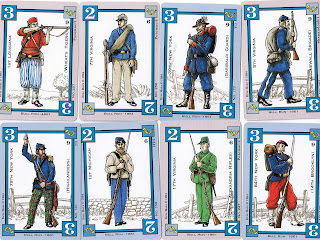
There are federal units in gray, rebels in blue and other combinations galore.
Dixie is definitely a wargamers kind of collectible game. It's got the kind of collectibility that should appeal to wargamers -- uniforms and OB while avoiding the kind of annoying collectibility found in many other CCGs such as promo cards, ultra rares and the like.
And if you don't want to do it the hard way, Columbia also offers a one-with-everything set that skips the whole random box scene.
The basic game is a good, introductory level tactical battle game that may appeal to the non-wargaming friends. The large cards highlight the kind of visual attractiveness usually seen in miniatures game and it avoid hexes and other wargamey conventions in favor of a very intuitive right-center-left battlefield.
Monday, December 22, 2008
Reviweing collectible games from a wargamer's perspective: Redemption
Redemption is a case of a collectible game that has some of the trappings of a military conflict game, but is really of limited interest to wargamers.
This bible-based card game was part of the first major wave of collectible games to hit the market in 1995 after Magic:The Gathering pioneered the concept. Unlike most of those 1995 games, however, Redemption has managed to stay in print all these years. While not a bad game, by any means, the relative success and longevity of Redemption has more to do with its appeal to a particular niche of the market -- the Christian (especially evangelical) market. While the game is non-denominational enough to appeal to any Christian belief and, indeed, could appeal to many secular-minded people as well, it's main reason for existing is the reality that there's a market for Christian themed products of all sorts for people who feel the wider secular popular culture has a lot of problematic elements from a moral stand point. There's an entire subculture of books, magazines, music, plays, television programs, movies and many other products oriented towards Christians that are largely invisible to the wider public.
While Magic: The Gathering was wildly popular, it posed a problem for Christian parents and teens because its full of topics most Christians find highly suspect, such as magic, evil characters placed on the same level as good, sacrifice and abominations of all sorts. So to provide an alternative that provided a more wholesome message while providing many of the same gaming experiences as M:TG Redemption was created.
The basic premise of the game is that heroes are being sent into the land of bondage to rescue lost souls. These heroes are opposed in their quest by Evil Characters. The Heroes and Evil Characters engage in a test of strength, comparing attack and defense strengths (in a diceless system similar to Magic: The Gathering). Both sides can be enhanced with cards and, as one might expect, there are various special cards that can be played as well. The cards are very attractive, with Biblical passages related to the card's theme and quality illustrations.
All the cards are based on events, people and themes from the Bible and it turns out to be a surprisingly rich source. There are even dragons!
Even though the game does include many warlike or military-sounding things such as bow and arrow, buckler and David's Sling there are also many decidedly unwarlike enhancements as well such as Gentleness, Joy, Shoes of Peace and the Submissiveness of Mary.
From a wargamer's point of view, the game is of limited interest, having little to do with military tactics and strategy. As with most CCG's card-playing skills such as hand-management and combo-building are more important than skills based on the traditional principles of war.
On the other hand, it's an accessible game that succeeds in providing an entertaining Christian-themed CCG. It's a somewhat easier game than Magic: The Gathering, making it easier to teach to non-gamers and younger children, but I think there's sufficient detail that deck building will still be interesting for experienced players. New expansions for the game come out about every two years or so, so the game is nowhere near the money sink that M:TG is. The company's Web site provides tournament materials, but there's little evidence of a strong tournament scene for the game.
I don't think most wargamers would seek this out, but if you happen to be a wargamer who also has an interest in Biblical themed games then I think you may find it of some interest.
Thursday, December 18, 2008
Reviewing collectible games from a wargaming perspective: Echelons of Fury
Like it's sister game, Echelons of Fire, the 1995 collectible game Echelons of Fury was an obvious imitator of Magic: The Gathering, with a similar sequence of play, combat mechanism and overall approach.
From a wargamer's perspective the World War II-themed Echelons of Fury may have a little more interest than the modern-themed Fire version of the game, but the game is still afflicted with the same flawed card selection and underdeveloped rules as the modern game and will generally be as frustrating.
As with the Fire game, Fury is a quite dead, so acquiring cards will tend to be fairly easy and inexpensive, if one is so inclined. Drafting decks from a common collection can create some interest and playing a game won't take all that long in most cases. The game allows for varying the deck size and the resulting level of headquarters damage needed for victory, but I think the game is best played with the minimum 40-card and 20 point HQ. Under those conditions the game plays quickly and you can get a whole series of games completed in a short period of time. Restricting the deck so severely makes the card choices more intense.
My particular collection happens to have a "brothel" card, which is not only amusing but shows where the designer missed an opportunity to differentiate his game from Magic: The Gathering and prospered. A big problem with the Echelons game sis that they are, frankly, kind of dull and dry. Throughout the game there's evidence that keeping costs down was a priority but I think this came at the cost of its long-time viability.
The "Brothel" card adds some spice to the game but also indicates how the game could have kept interest fresh by mining some of the rich history of the vast conflict. For example, the game as printed suffers from an excess of identical common cards. Anyone who acquires more than a few decks worth will have far more regular infantry squads, light machine guns and bazookas than they could ever hope to use. But by simply labeling the cards with the names and histories of famous fighting units the collectibility and historical interest of the game could have been heightened. Perhaps a Squad from the Big Red One 1st Infantry Division and one from the Bloody Bucket 28th Infantry Division would have been the same in game terms, but they would have given players less reason to feel cheated when they opened a booster pack and got yet another coupe of common squads.
Likewise many more flavorful special events could have been brought into play with more creative cards like the Brothel card hinted at. World War II was full of strange and unusual events that could provide fodder for cool cards.
As it turned out, the collectible game market is fiercely competitive and there appears to only be room for a handful of hot titles at any given time. Without a hook that could help it stand out in the crowd Echelons of Fury joined Echelons of Fire in the bargain bins.
Had the game lasted longer it might have had time to work out some of the kinks in the game design. It's easy to forget today that many of the early Magic sets had some real problem cards and rules that led to some significant changes and left a legacy of banned and restricted cards. It's been a few years since Magic had to ban a card in play and I think this reflects the intense development process the company uses.
Players of Echelons of Fury will have to make their own fixes, but considering that all play will be among friends in casual play this should not be difficult.
Overall, I think Echelons of Fury is a mildly amusing light war-themed card game that would be worth getting on the cheap if you get the chance, but not anything you'll particularly miss if it passes you by.
Thursday, December 11, 2008
The pros and cons of collectible game - a wargaming view
Over the next few weeks I plan to review some of the collectible games I'm familiar with from a wargaming hobby point of view.
By definition these will all be collectible games or have collectible-like features so rather than repeating this discussion for every review I thought it might be better to address the pros and cons of the collectibilty concept as it applies to the whole class.
I think there are several ways that collectibility affects a game system that will be important to the typical wargamer, who will generally have had little exposure to the concept unless he also has general game interests.
Wargames have heavily used the idea of expansions and expandability, of course. One of the very first SPI projects was the Blitzkrieg Expansion Module, which added all sorts of bells and whistles to Avalon Hill's Blitzkrieg and required possession of the original game in order to play.
The idea of a metagame involving army building goes back to at least PanzerBlitz and its optional point-based scenarios and competitive tournament play has always been a part of the board wargaming hobby since it reached a critical mass big enough to support conventions. And, of course, wargaming has always been a wallet-stripping hobby where there's persistent temptation to spend money on gaming stuff that you'll never end up actually playing.
Still, these various elements, which are peripheral to wargaming, all play a significantly enhanced role in the collectible game hobby experience.
For example, the money sink. As long as a collectible game is "alive," serious players are really required to sink a lot of money into that particular gaming line. While individual booster packs are relatively low priced in real terms (usually $10-$15, about the cost of a fast-food meal for two or a DVD) in the aggregate they add up to a significantly more expensive way to game than board wargaming and can even exceed the cost of a typical traditional miniature wargamer's budget. While $100 is a lot by board wargame standards and will usually buy you a big game like Axis & Allies: Anniversary edition, Tide of Iron or War of the Ring or let you buy a base game and at least one expansion like Memoir'44 or Combat Commander, for most collectible games it's just the down payment on a minimally competitive set.
In addition, "living" collectible games almost always have planned obsolescence for components as older sets get "retired" from official sanctioned play.
These aspects of collectible games generally make them unattractive to wargamers. Typically being a serious player of a collectible game will easily take up the entire game budget for most people. Buying just one or two boosters per week will add up to an annual cost of $700-$1,000. Spending much less than that will mean you can't expect to be competitive in sanctioned play.
There are, of course, ways to ease the financial strain, but no way to eliminate it. The simplest is to simply wait until the game "dies." While, in theory, a collectible game that goes out of print should remain just as playable as it was before, in practice going out of print generally means an end to sanctioned official play and a loss of interest among players. On the other hand, however, it usually means game elements are available for less in the secondary market and often mean the game will be in "bargain bins" in stores. It can be also be cheaper to fill out your constructed decks and warbands by purchasing the elements you need from online retailers, although the most desirable elements can be prohibitively expensive.
The whole collectibility concept is built around competitive play and the resulting metagame. This is not necessarily a drawback. The most active competitive playing venues in gaming are built around collectible games, with sanctioned tournaments every week in most areas. By contrast, competitive play for most board wargames is restricted to a couple of national conventions and a handful of regional cons. I don't think competitive play is a large motivation for wargamers, but for that smaller subset that wants it collectible games provide it in spades.
Even of it were not so expensive in money, collectible games are expensive in time. The largest part of the gamer's energy is expended in deck or warband construction. Building a competitive army will take a lot of thinking, studying and experimenting. This is, again, not necessarily a negative thing. If one counts the hours spent plotting, studying and thinking as part of the "playing" time than collectible games are not so expensive after all in entertainment value. This aspect of collectible games may be the most attractive to wargamers, who often enjoy that kind of "offline" game experience anyway. Most wargames are played solitaire, after all, with wargamers often studying their games intensely outside of playing time against an opponent.
To some extent all collectible games share these three characteristics: Cost, competition and consuming of time. For many wargamers any or all of these may make any collectible game a non-starter for them. But if not, then it's worth looking at the specific characteristics of a particular game to see if it's of potential interest for wargamers.
Monday, November 10, 2008
So what happens to HeroClix now?
Topps announces it's closing up shop on HeroClix: http://www.wizkidsgames.com/wk_article.asp?cid=41914
So where does that leave the HeroClix community in the future?
The precedents aren't good. It seems that collectible games need the injection of fresh product in order to stay alive and played.
While there are examples of long out-of-print board games that keep getting played such as Up Front, this doesn't seem to happen often with collectibles.
I think HeroClix has a big enough universe of figures to be playable indefinitely, but without organized tournament play I wonder if players will lose interest. Or will scenario-based play now become the preferred way?
Crossposted from BoardgameGeek
Monday, September 1, 2008
Dreamblade -- So what felled it?
Dreamblade was meant to be the "next big thing" in collectible/tradeable games.
Undoubtedly Wizards of the Coast/Hasbro conducted enough market research to persuade them it had potential. It had a big roll out, with big money tournaments and extensive Magic:The Gathering-style store support.
It's a pretty good game, with interesting strategies, an appropriate theme that gave players a sense of what the game was about while providing few constraints for designers, and some innovative ideas.
The physical presentation was top-notch, with a well-illustrated and clearly explained rule book. The miniatures were outstanding, with great art, fascinating and clever sculpts and ending up with an extensive line of 300 different figures from the base set and four expansions.
The game seems to have been generally well-received. On BGG it's rating of 7.39 places it at No. 282 among the tens of thousands of game titles rated by the site. This puts it about as popular as Bang! and World War II: Barbarossa to Berlin. It's owned by 617 BGG folks and has been played some 2,301 times by 273 distinct users, which also makes it pretty popular by BoardgameGeek standards. It has 15 pages of images on the site, another sign of some enthusiasm.
Yet, despite all this, the game ended up getting cancelled by WOTC before it's second anniversary.
I think Dreamblade's fate may illustrate the pitfalls of the collectible format for marketing a game. While obviously a great money-maker for a game company if it takes off, going collectible may raise the bar a lot for a game title. It's either all or nothing. Huge success or death. Despite being pretty darn successful by traditional boardgame standards, as a collectible game DreamBlade couldn't make the cut.
Most of the collectible figure games that have been successful seem to be based on some outside theme, not a self-contained one. It may be a fictional setting like HeroClix or Star Wars, a game universe like D&D or Halo or historical like Axis & Allies or Pirates, but figure-based games seem to need an anchor.
There may be some other reasons why DreamBlade faltered as well. I think the pace of the expansions was a bit too aggressive for most players to keep up with. There was a problem with balance with some pieces. Most tournament winning warbands seemed to have three Scarab Warcharms and most featured multiple rares. One piece (Kitsune) had to be banned.
Still, most collectible games have some problems with balance and Dreamblades expansion schedule wasn't more aggressive than HeroClix, so I doubt these were sufficient.
I know for myself, I'm very unlikely to take a chance on another collectible figure game based on a standalone theme.
Thursday, July 24, 2008
Lord of the Rings: Tradeable Miniatures Game scenario -- Fangorn Forest
Fangorn Forest
A LOTR:TMG scenario based on the Fellowship of the Ring movie/book
Order of Battle:
Evil: Match the build of the Good side under standard army construction rules. The Bad force must include a version of Ugluk and a version of Grishnakh. If needed for leadership, the Bad force can optionally include versions of Snaga, Orc Lackey and/or Orc Overseer as needed and available. At least half but no more than two-thirds of the figures must be Uruk-Hai (not Mordor) and the remainder must be Orcs.
Good: As many Riders of Rohan as the player as available, fielded within standard army construction rules. The Good force must include a version of Eomer. The good force must also include any version of Merry and Pippin. The hobbits can be used to satisfy leadership requirements under the standard army construction rules. All the non-hobbit figures must be mounted except for a couple of foot Rohan figures to even off point totals. The value of the foot Rohan figures cannot exceed the point value of the cheapest mounted figure in the force. Once the good army total has been determined, give that information to the Evil force commander
Map:. Any one map that does not include buildings. Treat water hexsides as land.
Set Up
The Evil Army:. The Evil player sets up all figures in the center of the map. One hobbit must be in the very center hex, the other is adjacent. All other Evil force figures must be set up adjacent to at least two others so that the whole force forms one compact mass
The Good army: The hobbits set up in the center of the map. They start the scenario captured. All other figures can enter the map from any side on any turn.
Special Rules
1. Any Good figure can leave the map by paying 1 movement point from a map edge hex. Figures may reenter the map on any subsequent turn.
2. Merry and Pippin are prisoners, but under the control of the Good player for movement. They are unarmed and cannot fight, but they also cannot be killed. So long as an evil figure is adjacent to them they are considered bound and can only move one hex per turn and cannot enter an occupied hex. If a hobbit starts a friendly movement phase without an Evil figure adjacent the hobbit is considered freed and can move normally, but cannot attack. If an Evil figure is adjacent at the start of a movement phase the hobbit is considered recaptured and bound again. Hobbits can escape and be recaptured any number of times.
Victory.
The Evil Army wins if the Good army is routed
The Good Army wins if the Evil army is routed or both hobbits exit the map from any map edge.
Monday, July 21, 2008
Navia Dratp, a twisted and sad saga of marketing madness
Metamorphosis is a fascinating chess-like abstract strategy game.
Players earn points by moving pawns forward, capturing opposing pieces and through some other piece-specific means. They can spend those points to metamorphose non-pawn pieces to more powerful versions or, in some cases, give the metamorphosed piece some new power.
The game has multiple ways to win: Capturing the opposing King, accumulating 60 points so the King can be metamorphosed into an Emperor or passing the king all the way across the board.
Described such, this probably sounds like a fairly easy-to-learn game that has the potential for some interesting and intricate game play. It could easily be themed, too, with wizards and dragons, insects, dream creatures, sci fi or even something whimsical.
Unfortunately BanDai, in the grip of some corporate madness, obscured this clever little strategy game under an overbearing weight of obscure and unpronounceable terms, bizarre figure art and collectible figures .
For those who wade through all that, there the reward of an intriguing game. And indeed, the game has recorded several hundred plays on BGG, which is a respectable number, exceeding all but a handful of wargames for example.
The game is Navia Dratp, and its name provides the first evidence of what was wrong with the marketing approach. If you're going to make up a name, why not make up one that people will know how to pronounce? Instead they include a silent "T' (it's Nah-Vee-ah Drahp) for know discernible reason.
Instead of calling the game's currency something obvious and easily understood such as points, or gold or jewels or whatever, they are called "Gyullas."
The game pieces bear names like Kapinah, Kapinahs (!?) Tanhoiser and Sungyullas.
And so on.
While marketing the game as a "collectible" game the maker left most of the pieces a very dark unpainted grey. In the initial offering only a small portion of the pieces were fully painted premium pieces. The second wave included one painted piece per booster, which was an improvement, albeit and inadequate one.
The sculpts are interesting in their own way, but too idiosyncratic to really draw the players in. There's an "anime" feel to the lot, but the most anime style pieces are the Navia (king) pieces,m which are rendered bizarrely as cute girls and some of their guard pieces. Most of the other pieces are more like something out of a horror movie. All that might have made some sense, except the background story for the Navia Dratp universe is very sketchy without enough information provided to really make sense of things.
Few games so professionally produced by a major company have been mismarketed so badly. Would the game have failed anyway? Perhaps. DreamBlade, which had a much more coherent marketing effort for a game that was also very interesting and well produced still didn't manage to do well enough to achieve breakthrough. (Although by boardgame standards it did rather well.)
But whatever chance Navia Dratp may have had was overwhelmed by the way it was presented.
Despite it all, however, there's an interesting game that's well worth playing. The multiple victory conditions, in particular, is a nice Eastern style touch that provides opportunities for misdirection and strategy. The interaction between pieces can lead to some unexpected combos that can tax the mind quite enjoyably. They also provide a universe of possibilities that would be unsolvable for a computer intelligence.
Ironically, the game's official demise may be good from a player's point of view. The base set and one expansion that were produced provide more than enough different pieces while stabilizing the game. Each player only needs seven pieces, so the five dozen or so available are sufficient. None of the pieces are overpowered, and indeed, most of the pieces are strictly limited in movement abilities, so there's little chance that a player will win because of the army he drafted instead of the cleverness of his play.
Navia Dratp ought to live on for quite a while as a small niche product that appeals to certain tastes.
Tuesday, May 27, 2008
Geeklist on CCGs from 1995
I have a Geeklist about 1995 CCGs on Boardgame Geek.
http://www.boardgamegeek.com/geeklist/31809
Friday, May 23, 2008
Echelons of Fire
By 1995 everyone seemed to jumping on the Collectible Card Game craze started by Magic: The Gathering two years earlier. The 1995 Origins convention book lists more than a dozen new designs, for example.
What wasn't yet clear was how Darwinian the competitive market environment would proove to be for collectible/trading style games. Because of the time and energy needed for the metagame of collecting and deck building, and perhaps more importantly, the wallet-emptying nature of that metagame, there really wasn't room for more than a handful of active collectible/tradeable games at one time. While there have been many CCG launches in the 15 years since Magic; The Gathering debuted, very few have survived. Many of the ones that fell by the wayside were good games, too. Unlike more traditional boardgames where moderate degrees of success were possible, for CCGs it was an either/or situation.
In the case of the modern-era military Echelons of Fire, and it's sister game World War II era Echelons of Fury, you have a game that's not bad, but certainly not great, and definitely unable to compete against M:TG.
Many of the Class of 1995 CCGs explored new ways to implement the CCG concept, but Echleons hewed fairly closely to the M:TG model. Indeed, in gameplay it's remarkably similar to M:TG. Instead of "mana" in five colors there are two types of supply (fuel and ammo) and combat is a deterministic comparing of numbers between attacking and "blocking" defenders, with unblksed attacks doing damage directly to the player. Just as in Magic, the player can take 20 points of damage.
There are some differences in detail between the two games, but these differences tend to the disadvantage of Echelons of Fire. In Magic: THe Gathering, the resource-providing land cards can be reused from turn to turn, but the supply cards in Echelons are tied down "maintaining" the combatant cards. This tends to hinder the dynamic nature of the game compared to M:TG. Likewise, the need to have maneuver cards in order to attack, and especially the fact that those maneuver cards can be lost in an unsuccessful attack, also tends to make the game more static than M:TG.
The biggest problem with the game, however, was the ill-considered card mix. While imitating the common-uncommon-rare pattern used in M:TG the game, the execution is flawed. For one thing, the common cards are way too common and repetitive, while having marginal usefulness in game terms. In M:TG even when cards are otherwise identical common cards, the artwork varied, adding to the collectibility. In Echelons they are all the same, and before long the player will far more fire teams and machineguns than he will ever need. This could have been mitigated by varying the illustrations perhaps, or adding unit IDs or something along those lines.
It's not all bad, though. The game does provide a quick-playing game system that captures some of the flavor of modern combat. Designing an effective deck is challenging and there's no one obvious strategy to follow.
The game avoids the overpowering "combo" problems common to Magic: The Gathering and many other CCGs. Constrained by the laws of physics and logistics, the most powerful weapons are also the most demanding on ammo and fuel, keeping their game impact within bounds. An M-1 Abrams can blast its way throug anything, but it takes three ammo and three fuel to field and by the time you get those cards in play you might be dead from repeated attacks from infantry squads.
The standard game has a 40-card deck with a 20 point headquarters target, but using such a small deck may not make the most of the different weapons systems available and I recommend generally usinga 60-card deck and a 30-point headquarters. This allows players to create more robust decks that give some scope for using the more powerful and interesting weapons such as the M-1, attack helicopters and aircraft. With larger decks it's best to limit the number of specialist elite infantry cards such as Airborne or Engineers to no more than 3 or 4.
The game is easy to get on the secondary market inexpensively.
Subscribe to:
Posts (Atom)