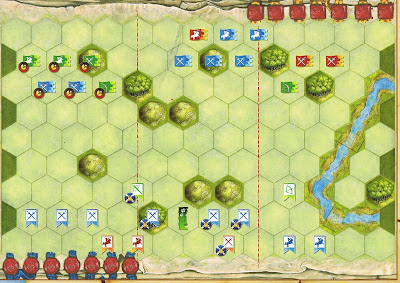
I like these sort of games, they are especially good if you can get a group going. Small World has a fantasy setting, compared to the historical setting of Vinci, which opens up the possibilities. This sort of thing isn't a simulation in any sense of the word, so I don't think much is lost by moving it to a fantasy world and there's a lot of potential gain.Commentary, reviews and news about games played by adults looking for a challenge.
Tuesday, March 17, 2009
Small World looks intriguing
I like these sort of games, they are especially good if you can get a group going. Small World has a fantasy setting, compared to the historical setting of Vinci, which opens up the possibilities. This sort of thing isn't a simulation in any sense of the word, so I don't think much is lost by moving it to a fantasy world and there's a lot of potential gain.Sunday, March 15, 2009
501st Post on Pawnderings
This started off as a catch-all general Seth blog, but I found the diversity of my interests made for a rather schizo blog -- posting one moment about some fun game and the next about some human rights abuse made for a rather jarring read.
Hence I split off the political commentary into its own blog at http://torteredillogic.blogspot.com where it seems to exist quite happily. That blog is mostly a place for me to vent, but feel free to check it out.
Recently I also started yet another blog to discuss in more detail the distressing state of the newspaper industry. It's called Death Notices and can be found here: http://newspaperslastdays.blogspot.com
My primary blog remains this one, however, because games are certainly a lot more fun to write about than politics and the press, even if less consequential.
Here's to the next 500 posts.
Saturday, March 14, 2009
That explains a lot, old age begins at 27!
To summarize, researchers suggest that mental ability peaks at 22 and starts to decline at 27. Presumably experience counts for a lot, and allows for improved performance for many decades afterwards, but the actual peak of our cognitive abilities comes much earlier.
I don't find this surprising, actually. Einstein made his biggest breakthroughs while still in his 20s and chess masters arrive at their exalted status as teens or young adults, not as people nearing retirement.
I've noticed that the intricate, detailed wargames that fascinated me as a young man no longer hold as much attraction now that I'm much older. I thought that I'd simply lost patience with them, or "matured" in my tastes or something like that. But it may be something as simple as the fact that I'm not quite as sharp as I was back then for that sort of thing. It's too much work now. Back then it didn't seem like work.
Friday, March 13, 2009
Reviewing collectible games from a wargamer's perspective: Axis & Allies miniatures
The biggest caveat is, of course, the collectible format.
The drawbacks are well-known. It can be expensive to acquire a reasonably sized set for playing
purposes, let alone for collecting. It tends to favor those with deep pockets who can afford to build up large collections. The blind purchase format can be aggravating, especially when you end up with larger numbers of common pieces than you can ever expect to use.These drawbacks are mitigated somewhat in A&A Minis, however. One can easily skip the whole blind purchase thing with purchases off of eBay and quite possibly save some money and certainly save a lot of aggravation. The pace of releases and the modest size of those releases
means that, unlike most collectible games, it really is possible to collect the entire set. There are no ultra-rare, chase or promo figures. All the promos given away so far have been the same common figures that came out in the main releases, with no repaints, special stats or other hard-to-get characteristics. Deep pockets are much less of a factor because there aren't overpowered units that unbalance the game. Armies are chosen on a point basis that has worked reasonably well, although some pieces have had to be re-costed. The laws of real-world physics and the dynamic interaction of real-world tactics means that even inherently powerful units such as the King Tiger tank have effective countermeasures available, Finally, there are, with a few exceptions, no really useless pieces in A&A miniatures because the figures can easily be used for other purposes. 
Indeed, quite a few people don't use the figures to play the provided A&A minis rules at all, but use the figures to play real miniatures games such as Flames of War or Battlefront.
I say "real" miniatures because, in reality, A&A miniatures is not really a miniatures game at all, but a hex-based tactical board wargame that happens to use miniature figures. It's really much more similar to something like Tide of Iron or Memoir '44 than like Flames of War.
That tactical game isn't bad. It's a very basic, simple tactical wargame with some interesting aspects and reasonable fidelity to history. It's primary purpose, however, is to give you some rules to use to play with your toys. Nothing wrong with that, but it's hard to imagine that someone who calls himself a wargamer won't already have some favorite tactical level World War II wargame. A&A minis won't supplant that game, although it may supplement it.
No, the primary reason for buying A&A miniatures are the figures, themselves. They are generally pretty well done and provide an interesting selection of forces, troop types and nations.
The first five sets (Base Set, Set II, D-Day, Contested Skies and Reserves) added up to 228
different units, although there were some duplicate sculptures, so the actual number of models is somewhat less than that. In each set it seemed like there was at least one disastrously bad model or error. For example, in Set II the US 3-inch M5 antitank gun ( No. 19 of 45) is a sorry little misshapen lump that barely resembles any kind of gun and is so out of scale it might be mistaken for a machin
e gun. Its completely unusable for any purpose. In the D-Day set there was the infamous "MesserSpit" model, where an error at the Chinese factory resulted in the Spitfire being represented by a German Me-109 fighter painted in British colors.And all the first five sets suffered from inconsistency in scale between models. The first five sets, although marketed as "15mm" were not really 15mm in scale as far as the vehicle models. There were closer to a 12mm scale, which meant they were incompatible with standard 15mm models from other manufacturers, much to the disappointment of many gamers. The 228 different units, however, gave the game a big enough set of alternatives to choose from that the game itself still worked and the problem figures were few enough that they didn't ruin the game.
Still, Hasbro/Wizards of the Coast took a big gamble when they issued the next sets because they changed the vehicle scale to a truer 15mm! This meant that all the earlier models were noticeably smaller than the new tanks. While having absolutely no game effect, it did have mess up the aesthetics of the game a bit. Still, they pressed ahead and the next three sets (1939-45, North Africa and Eastern Front) now add up to 180 different units (with some duplicates) including reissues of most of the important fighting vehicles from the first sets in the new, larger size. Players seem to have accepted this change and with the next set the newer,larger size will constitute a majority of the line. (The newer sets are also larger, with 60 different units, compared to the 45-48 of the first sets).
Quality control seems improved, with no absolutely horrid mistakes like the M3 or MesserSpit showing up, although a few of the models have come in for some criticism from purists.
The new, larger size for the tanks also resulted in a change in the maps being used, going to 3-inch hexes instead of the 2-inch hexes used before. Many of the late war heavy tanks and assault guns were simply way too big for a 2-inch hex.
When I first heard about Axis & Allies Miniatures I was excited, hoping that it might bring more interest to historical topics and history-based wargaming. The fact that it's gone through eight sets and spun off two naval sets with at least two more sets in the wings would have been too much to hope for, especially in the hyper-competitive niche market of collectible games. What helps A&A minis in that market is that I think there is relatively little overlap between A&A players and the players of other competitive collectibles. I also think Hasbro/WOTC seems to have had realistic expectations for the game and it has met their marketing goals (something that Dreamblade did not do, which resulted in its demise, even though I suspect its sales figures were similar).
I think the game is worth a look for the wargamer who might be tempted to trya collectible game. I've generally bought the boosters in small batches with an occasional purchase of a case. When I'm down to needing my last four or five rares I'll go ahead and buy them on eBay to fill out the collection. Following this strategy I've been able to complete the first six sets without breaking the bank and having useful numbers of the uncommons and commons for gaming. Having a little imbalance among my rares doesn't bother me, I consider it to just add a little personality to my choices. But one can also buy whole sets off eBay easily enough.
If just starting out, however, I wouldn't recommend going back and buying from the first five sets unless your a completist collector. Nearly all of the models from the first set will be reissued at some point, if they haven't already. If you're just getting into the game, it's safe to start with
the current 1939-45 starter. The most interesting figures that haven't been re-issued as of yet are the amphibious craft from D-Day, the logistic and fortification units from the last two sets and the heroes from those sets. It may be a while before the amphibs show up again, because at the new scale they may be too big, but the other figures are cheap enough on eBay.Overall, I would recommend the game, despite the collectible aspect.
Wednesday, March 11, 2009
Axis and Allies Miniatures: MAS 7.5mm Rifle
After the armistice most of the French army was disbanded and sent home, but significant forces remained on duty, particularly in the various French colonies. These troops, in West and North Africa, the Middle East and Indochina saw fighting later in the war during sharp, but brief campaigns against the United States, Commonwealth and Japanese forces.
Base set figure
Saturday, March 7, 2009
ZOCs
No, it wasn't a breakfast cereal. It was the infamous "Zone of Control." All the earliest Avalon Hill classics had them, as did most of the old SPI quads and their kin. I learned about them so early in my wargame career that for a long time I gave them little thought, despite some articles in MOVES magazine about them. It was easy to forget what an artificial thing they were, and how they could distort game tactics.
Mastering the effects of ZOCs was required for good play in those old classics, but I don't think they really added much in the way of realism. One of the refreshing things about XTR's games was that almost all of them dispensed with ZOCs.
When you really think about it, a ZOC probably means that the there's a mismatch between the size of a unit and the size of the hexes. If a division can cover a 12-mile front then perhaps the hexes ought to be 12-miles across and not 4 miles across with ZOCs accounting for the other 8 miles.
ZOC rules lead to oddities such as occupying every other hex along a hex grain, whereas in actual operations you would generally occupy a more-or-less continuous line.
Overall, I think ZOCs are best dispensed with.
Wednesday, March 4, 2009
More Lore, please
Tuesday, March 3, 2009
Candy Land movie?!
My wars
Quite a few Twilight Zone episodes were set in World War II, which is no surprise considering that Rod Serling was a combat vet himself. The war was also a popular theme for other TV shows. Some were action-oriented like Combat, Rat Patrol and 12-O'Clock High. Others were even comedies like McHale's Navy and, amazingly, Hogan's Heroes set in a prison camp.
And World War II movies were omnipresent on afternoon TV movie shows.
While my dad was a Korean War vet (the forgotten war) my best friend's dad was a veteran of Guadalcanal and we were therefore really excited when we found out there was an Avalon Hill game on the topic.
My own kids seem far less interested in such things, I guess because my own wars lack the drama of World War II, but I did get to serve in at least two wars in my own military career.
The least dramatic, although perhaps more important,was the Cold War. I served, like so many others, in the struggle between the democratic West and the Reds. Although it was a shooting war in some places and times, notably Korea and Vietnam, most of it involved little shooting but a
The 1st Battalion, 80th Field Artillery was equipped with the Lance, a tactical ballistic missile that could be armed with a conventional warhead, but was primarily meant as a nuclear delivery system.
The counter depicts the missile on its portable launcher as deployed for airmobile use, but that was a rarely used capability that, frankly, seemed untenable on a battlefield. While the launcher had wheels, you couldn't safely tow the missile that way.
Instead the missile was almost invariably deployed on its fully tracked carrier, as example of
which is shown here on display at the Field Artillery Museum at Fort Sill, Okla.:Ironically, by going to Germany I may have missed out on being deployed to the shooting war that DID occur during my active duty stint, the Invasion of Grenada. I was on active duty in the first place because I had done well at the Field Artillery Officer Basic Course at Fort Sill. At the time they offered the top-performing reserve component officer the chance to go on active duty and I had the choice of going to Germany or going to Fort Bragg to be in the 82nd Airborne.
I had long wanted to go to Germany (I even took German in high school) so it was an easy choice, but in retrospect it's easy to se how things could have been different. Whether or not I would have happened to be part of the 82d that deployed to Grenada is impossible to say, but it was a possibility.
I likewise missed the First Gulf War, being at the time in the 26th Yankee Infantry Division. At the time the National Guard insisted that only whole units should be deployed. This meant that, given that no infantry divisions were needed, that the only Mass. National Guard units that saw combat were some non-divisional MP and truck units. The Guard changed their mind about that rule.
As my military career seemed about to wind down without seeing any action whatsoever, I was quite surprised to get a summons to active duty in 2003! I was in the Individual Ready Reserve by then, the non-drilling reserve component. Apparently the Army was short on field grade
officers to man all the headquarters units it was creating to manage the second war in the Gulf and I ended up serving in Iraq with the Joint Special Operations Task Force North. This was an unusual unit. Basically it created a Corps-level headquarters around the core of the regimental-sized 10th Special Forces Group headquarters. Naturally, as a special forces group headquarters there were vast areas of expertise required for conventional operations and corps-sized responsibilities that the unit didn't have. So it was beefed up with all sorts of folks, from Navy SEALS, to National Guardsman, Air Force personnel, Marines, OGA (other govt' agency -- i.e. CIA) and, yes, IRRs like me.The counter above, from the game Operation Iraqi Freedom, depicts some of the Special Forces troops that were part of JSOTF-N.
As it turned out, the refusal of the Turkish government to allow the 4th Mech Division to invade Iraq from the north meant I didn't personally have a very active war, as I was assigned to the "ground fires" section that was responsible for coordinating artillery fire. In the actual event there was just one 6-gun battery of 105m howitzers in our area that the 173rd Airborne Brigade brought along and all the fire support that the special forces teams received was in the form of air strikes coordinated by the Air Force folks instead of us.
I did get to serve, and although it wasn't a time of high drama personally, I've been around long enough to recognize that every small bit part does play its role in the larger story. War and politics being unpredictable, it's hard to say that things might not have played out differently. Or even that the way events did unfold was not in part because of our presence. Certainly the JSOTF-N did occupy the attention of a dozen Iraqi divisions using little more than three battalions-worth of green berets, some Kurds and about four battalions worth of Marines, paratroopers and mountain light infantry. There's little glory in an Economy of Force mission, but it's a Principle of War for good reason.
Here's me in Iraq:

That's one of the special ops helicopters used to support the green berets and other special operators.
Saturday, February 28, 2009
Getting a Clue
Hope they do a better job than last time.
Supposedly there are a bunch of other movie projects based on Hasbro games including Monopoly.
I wonder if they'll do PanzerBlitz, ASL or Axis & Allies movies? ;) THAT would be something remarkable.
Thursday, February 26, 2009
Intricacy vs. realism in wargames
Some of this is bookkeeping work, either with papers or markers, that seeks to track some of the varied factors that affect battle outcomes in the real world such as fatigue, casualties, ammunition, fuel, etc.
Some fiddliness comes from the detailed accounting of military strength, of movement allowance and terrain effects.
Some results from intricate game phasing and procedures that try to account for weapons effects, doctrinal practice or communication.
Wargames are, indeed, rather intricate, and I think this results from a fundamental tension between design goals.
No, this is not another entry in the realism vs. playability debate, although it's related.
No, the tension is between the game designer's need to represent the decision points that the player/commander should influence and the need to provide the entertainment value of the game player as a witness to the spectacle of combat.
A real-life commander at any level has very limited means for knowing what's going on and issuing orders to try to influence the action.
During the battle of Waterloo, for example, Napoleon probably issued no more than a half-dozen orders all day. He certainly wasn't involved in any activity that remotely resembled counting combat factors, coordinating the precise configuration of attacking divisions and assessing exactly how many movement factors were needed to get everyone in position.
When Lee ordered Pickett's Charge at Gettysburg he issued only the most general guidance to Longstreet, with his biggest role being assigning the attacking divisions and specifying the point of attack. A player/Lee will be far more involved in the details.
Some of this work is, of course, a consequence of the physical limitations of a manual wargame, but not all of it is, as can be seen when you look at turn-based computer wargames which could strictly limit the player to a historical amount of control, but typically don't.
Indeed, even a manual wargame doesn't have to get down into the weeds. Is Memoir' 44 an unrealistic wargame because it doesn't have a lot of detail -- or is it actually a more realistic game because the player/commander doesn't do much more than issue general orders to attack or move here or there?
What Memoir'44 doesn't do is allow the player to witness all the activity that's going on. A unit moves, takes a shot (rolls dice) and something happens (or not) to the target. Exactly what going on when the target loses a figure and retreats a hex isn't specified. Are those losses casualties or deserters? Is the retreat orderly or a a near rout?
At the other end of the spectrum you have a game like Advanced Squad Leader, which depicts the action in excruciating detail, down to the facing of individual tank turrets, the malfunctioning of individual weapons and whether a squad passes through a building or alongside of it. The player has far more control of the action than any real-life commander could dream of. Indeed, the player has more control of each piece than the commander of that piece would have. Maneuvering a tank through a village the player controls every increment of movement, every swing of the turret, while knowing the exact lay of the land -- things even the actual tank commander couldn't do.
But it's entertaining as hell, which is why ASL is such an involving game to play. But witnessing every detail of the action comes at a considerable cost in "fiddliness." And at the end of the day, after executing a half-dozen die rolls and following several procedures you end up with a result -- which could have been expressed as "you lose a half squad and they have to rout to that patch of woods." Not all that different than Memoir '44.
Non wargames can generally dispense with a lot of details because the entertainment value of the game is heavily focused on the decisions of the players and the interactions between them. Exactly how the conflict (if there is any) or other actions are resolved is neither here nor there.
Player decision-making can be important in wargames, too, but it's not even necessarily of first importance. In many wargames the player has surprisingly little real impact on the course of the game and in most wargames there can be a lot of entertainment found in playing the game solitaire. Players of nonwargames may play the game through alone on occasion to learn the rules better or try out a strategy but I don't think they do it regularly. The game's fun is provided by the social interactions and the chance to match wits with an opponent.
On the other hand, a wargame can be very entertaining to play alone because a big chunk of its appeal is in witnessing how the action unfolds. Providing that appeal requires that the "how" be depicted and that, I think, is one of the factors that distinguish wargames from other games.
Saturday, February 21, 2009
A not so complex web
The character of the two games we played could not have been more different.
In the first battle the Old Warhorse took the role of Owain the Red Hand (the standards army, with the dwarves and spider).
Despite the presence of level 1 wizards on both sides and the spider, this turned into a very conventional battle. Neither wiz was all that effective, again, as being level 1 definitely reduces the impact of the best spells. And it never seemed worthwhile to activate the spider, so that unusual creature took absolutely no part in the battle.
Instead it turned into a battle of quality. Both sides used Mounted Charges to god effect, but the Goblins once again lived up to their reputation of not being worth the trouble as they melted away when facing the dwarves. In the meantime the dwarves chewed through everything they faced and the battle ended up a fairly convincing 6-3 win for the dwarf side.
When we switched sides, on the other hand, the battle was a free-wheeling affair The Young General got a lot of use out of the spider, which turned into a real bane for Edward's troops. Both sides again made extensive use of Mounted Charges which decimated both cavalry forces by the time it was over. Both sides did a lot of spell-casting as Young General finally got over his aversion to spending Lore. While not decisive,the spells definitely provided important support. Still, the star of the battle was clearly the Spider, which avoided many critical hit rolls while laying waste to the opposing army. The final score was 6-5 for the Dwarves, so Young General added another notch to his belt with a win over the Old Warhorse.
Friday, February 20, 2009
Seega, a review
While five by five boards are seen carved in ancient stoneworks there's apparently no proof that Seega was played on them and Bell and others apparently think the game is of recent origin, perhaps the 18th century.
On the other hand, it's quite possible it's a very old game indeed. Like many very old games it's very abstract, relying on a handful of easy-to-remember and teach rules suitable for an oral culture. It doesn't require any special materials. The game's grid can be scratched out in the sand and sticks and stones can be used for the pieces.
Like some other ancient grid-based games the exact number of spaces could vary from time to time and place to place. (Go, Latrunculi, Morris also have this characteristic) The main effect of adding pieces is to lengthen playing time, so the most popular version is the simple 5 by 5 grid.
While associated with Egypt, the game is apparently more popular these days in Somalia, according to Bell and others. It's apparently played in West Africa as well, however, as the World of Games book has a photo showing a group of boys in Senegal playing the game in the sand.
The game uses the same two-phase organization seen in Nine-men's Morris and Kensington, where the players begin by alternately placing pieces on the board without moving them (and in Seega's case, not capturing them) followed by a second phase when player's alternate moving one piece from a square to an adjacent unoccupied square. The game uses the ancient "custodial capture" technique, where a piece is taken if an enemy token moves next to in such a way as to "sandwich" it between the moving piece and and another enemy piece. If the capture is made then the capturing player can move again.A player wins by capturing all but one enemy piece. An alternative way to win is by blocking the opponent so he cannot move. In this case whoever has the most pieces left wins.
As one can see, the game mechanics are very, very simple and very ancient as well, which lends credence to the belief that the game is older than believed. I think the fact that it's generally played with ephemeral materials and has no need for written rules has obscured its ancient origins. It doesn't seem to have inspired the religious associations that helped preserve Senet or the urge to create beautiful playing materials that's helped provide evidence for the antiquity of Go or Chess. But I think the internal evidence provided by the games rules suggest it's rather older than credited.
As a capturing game, there' s a tendency for a rich-get-richer and poor-get-poorer effect to kick in. The initial placement is vital, with corners and side positions to be prized. A piece in the central square is immune from capture, making this a useful location in the early game.It's a quick-playing game, but one that will have trouble keeping the interest of adult players, especially those who have been exposed to more sophisticated abstracts. It can be some fun played with younger players, helping them develop some tactical skill in analyzing board positions.
While there are versions available for purchase, there's really no need to buy one as the game is easily fabricated with materials at hand. Simply draw a 5 x 5 grid on a piece of paper, put an "X" in the middle square, dig out a dozen pennies and a dozen nickels out of the coin jar and you have all you need to play. For those who want something fancier, The World Of Games describes how to build a set using a leather board and polished stones.
Wednesday, February 18, 2009
Trying to revive Heroclix
Tuesday, February 17, 2009
Marvel and Hasbro extend license deal
http://uk.reuters.com/article/autoNews/idUKTRE51G3IW20090217
This may clear the way for more Marvel-theme related games, such as Heroscape.
Chattanooga

Using a variation on the game system first seen in Fateful Lightning, Chattanooga is heavily weighted towards morale effects, rather than factor counting or numbers. Units are rated for “Intensity” which measures its willingness to enter into close combat, and “Morale” which measures staying power.
In addition to the standard historical scenario, there are two other scenarios. One assumes that Bragg had followed up his success at Chickamauga and pressed the pursuit harder. This results in a low-counter-density scenario that makes a good introduction to the entire game system. The second scenario covers a smaller preliminary night battle on 28 October.
The battlefield is very open, with some prodigious slopes restricting maneuver in some key spots.The game system is unusual, and is a departure from the usual XTR/Command style. While a “mini-monster” the game does not use standard wargame mechanics and instead uses an
uncommon and rather intricate game system, by Command standards. Every hex represents about 176 yards, units are regiments of infantry and artillery batteries. The game uses the universal color scheme of Civil War games, blue for the federals and gray for the confederates. Units show iconic representations of the soldiers on each side, in a variety of poses and uniforms. Unlike Fateful Lightning, however, which depicted each unit in its correct uniform, Chattanooga does not. Turns represent two hours during daylight, plus an overnight turn. Each turn comprise player “couplets,” which might be considered turns in most other games. How many couplets make up a turn varies. After each couplet a die is rolled. Depending on the result play proceeds to another couplet with the same side going first, or to another couplet with the player order reversed or the end of the turn.Combat is handled in an unusual way. Ranged fire combat is possible, but tends to be indecisive and long ranged shots are hard to set up because of the amount of woods. Surprisingly, firing units can suffer adverse results when they shoot. The number of firing factors is added up and a 10-sided die rolled. Results tend to be disruptions and morale checks. Much of the combat will consist of assaults. Assault combat is resolved by selecting a column on the CRT based on the attacking units’ intensity and then rolling a 10-sided die. Both intensity and the die roll can be affected by a number of modifiers. I found this system rather burdensome and even arduous, because it meant a large number of repetitive calculations. There are likely to be dozens of combats in each player couplet, each one involving adding up modifiers, which will generally tend to be very similar.
The games includes a number of other unusual subsystems, such as "extra strength" which is used to recreate units from the dead pile. Units can also be recreated without using extra strength, but risk being permanently eliminated at a victory point cost. The game does appear to be a reasonable simulation, but its level of detail and the work required of each player will restrict its appeal to hard-core gamers with a particular interest in the topic.
Recommendations
(Conditional Yes) For Wargamers: A large and detailed replication of the Battle of Chattanooga for Civil War and tactical game buffs. It’s of limited interest to others.
(No) For Collectors: Nothing special.
(No) For Euro gamers: A very hard-core hex-and-counter wargame.