Monday, January 26, 2009

Wednesday, January 21, 2009

Reviewing collectible games from a wargamer's perspective: Lord of the Rings Tradeable Miniatures Game

Lord of the Rings: Tradeable Miniatures Game is a very wargamey skirmish level collectible miniatures game.


Each miniature represents a single combatant and, while undefined, each turn rather obviously represents just a few seconds of time.


The miniatures, themselves, are very impressive. Very well sculpted, humans are about 40 mm high, making them rather large by the standards of wargame-style miniatures. All the figures are based on the movie trilogy interpretation of the Lord of the Rings world, not directly on the books, so Tolkien fans may find things to quibble about. (Fantasy Flight's War of the Ring, in contrast, is based on the books, giving fans different things to quibble about). While not always faithful to the books, the LOTR:TNG is definitely faithful to the movie.


The key element of the game design are the Combat Hex bases, which use adjustable indicators to track the changing status of each fighting piece. In the first set these indicators took the form of sliding tabs, one on either side of the figure base, which kept track of the number of hits the unit could take and the number of "action points" available. The action points are used to activate various special powers, give units additional movement or allow some die rolls to be changed. In later sets the indicators were changed to dials with the same functions.


Other data on the base includes the name of the piece, its collector number, its point vale, attack strength, defense strength, movement allowance and, in the case of missile units, a range and combat strength for missile fire.


The combat strength number indicates how many dice the unit is entitled to roll when it attacks, with 4 or better being a hit and a 1 being a "glancing blow" that i eligible for conversion into a hit if action points are spent to do so. Once the number of potential hits is determined the dice are rolled again in a "damage roll" and the defense value indicates what die roll is needed to inflict a hit. For example, a Rohirrim Archer (BS73) rolls one die in a melee attack. If he rolls a 4 hit gets a potential hit. and rolls again. If fighting an Orc Spearman (BS16) whose defense value is a "3" any damage roll of a 3 or better will inflict a hit on the Orc.

Many characters, especially named heroes such a Aragorn, Gandalf or Frodo have special abilities which grant additional combat or mobility powers. Using these powers requires spending "action points" with the number of points varying on the character and the power. The point values of the characters reflect not just their raw combat values but also the number of their special abilities and how much they cost to activate.

Combat and movement are pretty standard skirmish level stuff, with the usual terrain effects and provisions for striking disengaging characters and the like. Each turn begins with a Strategy Phase where a die roil determines initiative and each player has the opportunity to spend action points to activate certain special abilities. The attacker then conducts an action phase for all his pieces, followed by the defender. During an Action Phase pieces can move, certain kinds of combat (such as shooting) can occur and some special abilities can be activated. After both sides have completed their action phases there is a general combat phase.

This combat phase is handled a little differently than most skirmish style games and is responsible for much of the unique feel of LOTR: TMG. In cases of single combat the two involved characters duel in the expected way, with each rolling their die or dice and inflicting potential hits as appropriate. Action points can also be spent to change a limited number of damage dice rolls to higher numbers as well. But in cases where there are multiple adjacent combatants players arrange their attacks in "chains' of engaged characters according to various common sense rules to group them. For example, two characters who happen to be adjacent but facing away from each other may no end up being in the same chain. All the attack dice from units in a chain are rolled at once and the number of potential hits determined. The damage roll is then made and the hits allocated to defending units in that chain by the attacker. Hits are resolved once both sides have had a chance to attack.

While resolving a large and complex chain can be time consuming, my sense is that it takes less time than resolving dozens or scores of individual combats as is the usual practice in similar games. It definitely creates a level of tactical cohesion that reflects melee combat well. There are real incentives to keep characters groups in an organized fashion appropriate to melee combat as seen in the movie and in real life. Some special abilities such as "bodyguard" can help keep the opponent from merely picking on the best heroes, who anyway tend to have a high number of hit points and high defense values. A hero such as the mounted Eomer (TT52) can take five hits to eliminate and those hits need to be a 5 or better so it can be difficult to take them out. On the other hand, a lowly Orc Warrior (BS19) only takes two hits and they only need to be a 3 or better so large swaths of Orc Warriors can disappear in short order from a large melee.

The overall effect is to capture rather well the large sweeping battles from the movie and make it possible to re-stage battles such as Helms Deep without being tedious.

On the other hand, the game is very tactical and military and I suspect that most LOTR fans were looking for something more narrative and even "heroic" in style and the game ended up being discontinued, although not before running through several expansions and providing a useful number of characters to stage most of the battles from the movie. All the major characters appear, with many appearing in several versions. Besides the normal human-scale figures such as Men, Orcs. Elves and Hobbits there were also a number of large pieces including Trolls, Fell Beasts, Treebeard, the Balrog and even Sauron himself.

From a wargamer's perspective LOTR:TMG is worthwhile, particularly for those who are also Tolkien fans. It provides some interesting tactical decisions in a unique but sensible skirmish-level wargame that allows staging fairly large man-to-man battles in a reasonable time. It's possible to stage battles involving a hundred or more figures and resolving them in a single sitting.

Some of the neater figures are hard to find now, as it doesn't appear that people owning the game are giving them up in large numbers, although when figures do appear on eBay they are generally priced reasonably. Starter kits are widely available, but of limited use because of the small figure selection. Players should always use the so-called "Tournament Rules" which are really a revised and clarified edition of the standard rules. There are still organized playing groups in some places, including an active group in the Midwest, but the game itself is officially discontinued and no longer supported with the official Web site take down (although still available elsewhere).

Because of the difficulty in acquiring a satisfying number of figures it's hard to recommend the game to new players, but if you get an opportunity to pick up someone's collection or find some boosters in the dusty corner of a game shop somewhere I would snap it up in a heartbeat.

Tuesday, January 20, 2009

First glance: Axis & Allies Anniversary Edition

I finally had a chance to get Axis & Allies Anniversary Edition on the table and I wasn't disappointed.

It's a big, grand and entertaining game.

I only played the original game a time or two and never played Revised, so I can't really compare it to those editions, but I like the presentation and play of this edition a lot.

The only thing that caught me a little by surprise is how long the game may end up being. We played a good five hours and got 6 or 7 turns done, but the game was definitely still up in the air when we had to call time. Russia had fallen, but unlike the earlier versions, in A&A:50 it appears that's not a reason to call the game for the Axis. While the Japanese were busy helping devour Russia and gobbling up China the British Empire and the USA were able to achieve absolute naval dominance over the globe and, in my opinion, the Axis were faced with a difficult question of "what next?"

It's not clear, but I'd sure like to play again and find out.

Monday, January 19, 2009

Heroclix has a future?

Perhaps, if this report is correct: http://www.icv2.com/articles/news/13924.html

The gist of the report is that Catalyst and Pinata have joined forces to bid for the Heroclix line.

Friday, January 16, 2009

Mattel buys Blokus, Whac-A-Mole games

According to AP Toy maker Mattel Inc. said Friday it bought Sekkoia SAS, which makes board game Blokus, for undisclosed financial terms.
In a separate transaction, Mattel also acquired the rights to the Whac-A-Mole game from Bob’s Space Racers Inc.
Financial terms of that transaction were not disclosed as well.
Mattel’s purchase of Sekkoia includes Blokus Trigon, Blokus 3D, Blokus Duo, and Blokus Giant.

I wonder if Mattel is going to make a run at challenging Hasbro's dominance in the boardgame sector.

Wednesday, January 14, 2009

Hoorah! review

Hoorah! Six Bridges: The Battle of Pittsburgh, 1 October, 1863 is a hex-and-counter wargame portraying a fictional battle for Pittsburgh during the American Civil War. A sequel to XTR’s Wahoo! Game, Hoorah assumes Lee won a substantial victory at Gettysburg and then followed up with a successful assault on Washington, D.C. Rather than ending the war, however, these battles widened it into a world war as Britain and France intervene on behalf of the Confederacy while Prussia and Russia come in on the Union side. In this new, wider, war, Lee decides to sever the east-west rail links of the United States by capturing Pittsburgh, in conjunction with a British Army from Canada. Meanwhile, Grant, leading the twice-defeated Army of the Potomac, tries to hold onto the city until help arrives in the form of Gen. Sherman and his western army and the river gunboat flotilla.

It was the issue game in issue No. 39 of Command Magazine in 1996. Also in that issue was Strike North, reviewed elsewhere. The one scenario covers the day-long battle with each turn representing 45 minutes and each hex about 400 yards. The Beth Queman map depicts the city of Pittsburgh, and the junction of the Allegheny and Monongahela rivers into the Ohio River. Units are brigades of infantry and cavalry, battalions of guns and single gunboats. The 15-page rulebook describes a game of moderate complexity by wargame standards with fairly standard Civil War brigade-level rules for combat and movement. All federal unit have one step and are therefore eliminated with a loss, while the British (well-trained) and Confederates (win streak) have two steps. The second step has one less combat and movement factor. This is the only thing I might have done differently. While the Army of the Potomac (defeated so many times, including Chancellorsville, Gettysburg and Washington in this timeline) deserves a fragile morale, I would have given the troops from the U.S. Army of the Tennessee (also unbeaten to this point) two steps as well. If players agree they can have a house rule to that effect. The Army of the Tennessee only has 11 brigades, so this will not change the game enormously.

The game uses a chit-pull corps activation mechanic, where all the units of a corps can move and fight together when their chit is pulled from a cup. The defending Union Army of the Potomac comprises six corps (I, II, VI, XI, XII and Cavalry) while the attacking Confederates are organized into three infantry corps and Stuart’s cavalry.

Compared to the historical units the Army of the Potomac is missing units lost in the first two battles or detached. The most significant missing formation is the Union Artillery Reserve, lost at Gettysburg. The rebel Army of North Virginia is stronger in artillery than the historical force, mostly equipped with guns and ammunition captured from that Artillery Reserve.

Coming in as reinforcements are the two-corps strong British Expeditionary Force, the three-corps strong U.S. Army of Tennessee and the 10-ship U.S.N. gunboat flotilla.

Finally, a series of (presumably hastily-constructed) Union forts and batteries surround the city.

The game revolves around the six bridges around Pittsburgh. At the end of 12 turns (nine hours) the Confederate player rolls a die. If he rolls less than or equal to the number of bridges he controls, he wins. Otherwise the Federals win a game victory. (The fact that there’s a battle at Pittsburgh at all can only be regarded as a dire strategic situation from the federal point of view!

While these sort of alternate history games are not for everyone -- and the situation admittedly far-fetched -- it does give the players a chance to explore a very unusual and challenging situation that is arguably more realistic in many ways than a more standard historical treatment.

For example, no matter how well done, every Gettysburg game is faced with the fact that both players have far more situational awareness than the actual commanders. Historically the actual confederate commander, Gen. Robert E. Lee, did not know exactly what he was facing, especially on the first day. He hoped he was catching part of the Union army unsupported and believed he had a chance to inflict a serious defeat on at least two corps. But the player Lee knows that he is facing the whole federal army and even has a list of what roads they are taking and when they will arrive.

So Hoorah provides players a chance to test their generalship in an unprecedented battle situation, where they have only a general idea of what COULD happen and do not have the guidance of what DID happen to help.

Besides the inherent chaos of the chit-pull mechanic the game adds a highly variable reinforcement rule and a combat results table with way more than the usual variability.

Dealing the CRT first, we note that it uses a two-die roll summed result instead of the typical D6 chart. With 11 different possible results ranging from 1/36 to 1/6-chance of occurring no combat is a sure thing except at the most extreme odds. Even a 1-5 attack has some fluke chance of carrying a position while even a 5-1 attack could be repulsed!

Meanwhile, both sides will be anxiously awaiting the reinforcements. Each group (BEF, river flotilla, Army of Tennessee and, optionally, Stuart’s horsemen) arrives on a die roll of a “1.” Over the course of a 12-turn game, all should arrive, but there is no guarantee when. A force that arrives on the first turn is rather more helpful than one that arrives on turn 11 or 12, for example. And there is no guarantee that they will arrive at all. We’ve all been unlucky enough to roll a die 12 times and NOT roll the “1” we need.

If a force does arrive, where it arrives is subject to further randomization. The BEF and Army of the Tennessee each have six arrival zones, with an unequal chance of arriving at each one. In MOST games both armies will arrive West of the Allegheny, across the river from Pittsburgh, leading to a big battle outside Allegheny City. But, sometimes, the BEF will show up from the East, behind the CSA line. And sometimes Sherman will appear south of the Monongahela. If detached on a “sweep” at the beginning of the game, Stuart’s six cavalry brigades could also show up either north or south of the city. Only the gunboats, necessarily restricted to the river, have only one entry zone.

The whole situation is extremely fluid. It has the potential to be very unbalanced (For example, flotilla and Army of Tennessee never arrive, BEF and horsemen arrive early on both flanks of the city, leading to the Army of the Potomac being surrounded and overwhelmed and all six bridges captured for an automatic victory) but real battles are seldom “fair.” The game is best looked at as a test of generalship (and even character) although not necessarily a fair test of skill. Unlike many unbalanced wargames, here switching sides and playing again will not be any help. (Now playing the Rebels, our unlucky former federal player from the first example sees with horror the flotilla and Army of Tennessee arrive early and bolster his foe’s line to stall the attack. Meanwhile the BEF arrives late and behind the Rebel line, which is already too crowded with units and that damn Stuart never does show up, leading to none of the bridges being captured and no chance of victory!). No, the relative generalship will have to be settled in the time-honored historical fashion, with arguments and recriminations afterwards!

The game takes about 20 minutes to set up and can be played in one sitting.

Recommendations

(Yes) For Wargamers: A very different challenge from the usual.

(No) For Collectors: No remarkable collectibility.

(No) For Euro gamers: A hex-and-counter wargames with intricate and detailed rules.

Tuesday, January 13, 2009

Reviewing collectible games from a wargamer's prespective: Dreamblade

Dreamblade is an abstract strategy collectible miniatures game that may be on ground that's a little more familiar to wargamers because dice and probabilities play a significant role in the game action.

The premise is that players are "dream lords" who can summon various creatures and locations to battle over the "dreamscape" for dominance over the dreams of mankind.

The premise isn't really all that important except that it provides an excuse for some really imaginative miniatures and allows pretty much any kind of game mechanic because there's no "reality" to constrict the design.

The basic structure of a game turn is simple. Players each roll a regular six-sided die, with the higher roll winning the initiative and performing subsequent game actions first. The total of the die rolls is the number of "spawn points" each player can use to summon new creatures to the dreamscape. The more powerful creatures cost more, naturally. During his turn each player can perform two actions, in any order, either "shifting" or "striking." During a "shift" a player can move any or all creatures one cell on the dreamscrape. During a "strike" a player can conduct combat in cells that his pieces with enemy pieces. To conduct combat players roll as many special battle dice as the total "power" (a characteristic) of the creatures in the fight. Two of the sides are misses and three of the sides bear the numbers 1, 2 and 3. The sum of those numbers is used to inflict damage on opposing creatures. If the total equals the defending creature's "defense" (a characteristic) then the target creature is disrupted and sent to another empty cell of the attacker's choice. If it equals the "life" (another, often higher, characteristic) then the target creature is destroyed. The final side of the die is a "blade" which, when rolled, often activates some special power listed on an attacking piece.

Naturally, as a collectible game there are numerous variations among the creatures and interesting interactions among them and the rules. Creatures can have special abilities activated through rolling blades, or spending spawn points during the spawn phase, or as they enter play, or as they occupy certain cells, etc.

The game is won by scoring victory points. The most common way to score points is by occupying "key cells" in the center nine squares of the 5 by 5 dreamscape that are worth varying numbers of conquest points and/or destroying enemy creatures for conquest points. Whoever scores the most conquest points win the turn and a victory point. First player to six victory points wins the game. It doesn't matter whether you win a turn by many conquest points or a few, so long as you win the turn. These can also be modified by some pieces.

As one can see, there's quite a bit of scope for strategy in the pure sense. As is always the case in collectible games, the first element of strategy is selecting your warband. Each player is limited to 16 pieces (unless modified by a special ability), so the selection of pieces involves a lot of analysis. It's good practice to include a good balance of spawn points among the selection so that any initiative roll can be used efficiently. If either player rolls a "1" then the spawn phase may be skipped (unless modified by special ability or by a tournament rule that prevents two consecutive skipped spawn phases) so a player is not guaranteed reinforcements, but it can be fatal if an opponent is able to spawn creatures and you cannot because you don't have creatures with the right spawn costs. Pieces come in one of four "aspects" which are basically factions that affect how much creatures cost and how well the work together, as well as provide a general guide for how they behave. For example, Passion creatures often have strong Power and can therefore attack well, but have low defense and life values and are therefore easily disrupted or destroyed.

Once a warband is selected there's a lot of thinking required about what order to summon your forces to the dreamscape, let alone what to do with them once they get there.

All in all it's a very deep and intricate game of the sort that will appeal to many wargamers. The biggest thing standing in the way will likely be the bizarre theme which, of course, bears no resemblance to reality, let alone any kind of history or warfare.

A lesser factor is the collectibility. Dreamblade is a discontinued game, so there is now a finite universe of pieces and boosters and singles can be had for reasonable prices except for a few prized pieces (especially the Scarab Warcharm, which still commands a premium). The competitive tournaments scene has ended, so all play now is basically casual play.

It's a reasonably popular game, according to BGG stats, with respectable numbers of plays for a boardgame, although obviously not the numbers that Hasbro/WOTC was looking for to support the game.

I like the game, but I have to admit that it's of questionable interest for wargamers. Many wargamers have other gaming interests of course, and if their those interests include abstract strategy or collectible games then I'd recommend Dreamblade. If, on the other hand, your interests are strongly geared toward historical or military-themed topics, then Dreamblade will likely be of minimal interest.

Monday, January 12, 2009

The Great War in the Near East review


The issue game in Command Magazine No. 37, The Great War in the Near East, is an add-on module for The Great War in Europe, which appeared in Command No. 33. It’s also playable as a standalone game. Like the parent game, the core standard wargame supply, movement and combat rules take up only five pages of the 20-page rule book. The balance of the rules describe the special rules needed to account for the special conditions of the Great War’s secondary fronts in the Caucasus, Palestine and Iraq.

Also like the parent game, the draw of chits provides the main engine for the game’s events. Unlike the earlier game, however, where players had some input into the pace of chit events because they paid resource points for them, in this game chit draws are automatic. Resource Points are so rare that players would never spend them on chits.

The map is compatible with the Great War in Europe. The Caucasus and Iraq maps are considered “East” maps and use the same 20-22.5-mile hexes as the parent Game’s Eastern Front. Palestine, on the other hand, is a “West” map, and uses the 9.5-mile hexes and double movement allowances of the French and Italian fronts in TGWIE. Unlike the parent game, where most units were divisions, this game also has many brigades and even some battalion- and company-sized units.

Fittingly for a secondary front, events in this game are driven in large measure by factors outside the player’s control. On each front, both players try to make do with minimal resources in supply and troops and make some headway. The game system ensures that the game follows history closely, and it is not easy to make dramatic departures from the historical script. Each front has only the most tenuous connection to the others. Even the Ottomans, who are the common belligerent on all three fronts, will find it hard to redeploy forces to take advantage of his interior lines.

The Allied objective is the force the surrender of Turkey by capturing “surrender towns.” During victory check turns the allies add the number of captured towns to a die roll, if it is 11 or more, the Allies win. The Central Powers win by avoiding a loss, except if the Army of Islam chit is drawn, in which case they must also capture the Russian city of Baku.

The Central Powers can optionally take six German shocktroop divisions in 1918. If they succumb to that temptation, they have to capture three Allied Victory hexes to win.

As a standalone game it takes about 20 minutes to set up and can be played in a long sitting. While there are potentially more than 50 turns, many will go by with little or no activity.

When combined with the parent game there is not too much of an addition in playing time for the same reason, although the combined game will certainly work best for team play, if for no other reason than coping with the mental adjustments needed to play, essentially, SIX simultaneous wargames!

There’s some minor overlap in the orders of battle, the duplicate units are marked with an “X” and set aside. The chit pool is also adjusted. There are some chits from each component game that are not used and several new ones specifically for the combined game that are added. Units from TGWINE are identified with a diagonal slash. Units used only in the combined game have the slash in red.

Recommendations

(Yes) For Wargamers: Primarily if one has The Great War in Europe. As a standalone game TGWINE is probably only for players with a special interest in one of the component campaigns.

(No) For Collectors: Nothing remarkable.

(No) For Euro gamers: No, no, no.

Sunday, January 11, 2009

Game review: The Moscow Option


The Moscow Option: Guderian's Gambit is one of two wargames in Command No. 37 (The other is Mukden).

It could be considered Proud Monster meets Budapest'45, because it marries a strategic option and the untried Soviet units from the first game with the combat/movement and unit roster system of the latter.

As a Budapest system game Moscow Option includes zones of control, a unit roster to track German step losses and 5/8-inch unit counters. The German player-turn starts with a mechanized movement phase, then goes to a combat phase and a general movement phase. The Soviets move and then fight.

But the game situation is drawn from an option in Proud Monster, where the Germans dedicate their supply network to supporting a spearhead of mobile units ( 9 Panzer divisions, six motorized divisions and three smaller units) lunging towards Moscow in an all-out bid to capture the Soviet capital and win the war. The 16 German infantry divisions plodding behind the armored spearheads can help hold ground, but have no attack factors at all.

The Soviet forces are all 1-step attack-defense-movement factor units identical in function to the Proud Monster Soviets. All start on their untried side, with values unknown to either player. When they enter combat for the first time their values are revealed. Being one-step units in the very attritional Budapest combat system, however, most Soviet units won't be around for long. The Soviets begin with 39 Rifle divisions, 5 cavalry divisions and 11 tank divisions. Another 28 Rifle divisions, 7 cavalry divisions, one tank division and 14 tank brigades come as reinforcements.

The German has 14 turns to capture a Moscow hex. Once he's in possession of one or more hexes he rolls two dice and compares the result to chart. The earlier he captures the hex(es) and the more hexes he holds the better his chances. For example, if he captures all three hexes by turn 6 he wins on any roll. If he just manages to squeak into one hex on turn 14 he'll need boxcars to win. The Germans win automatically by clearing the map of Soviet troops. The Soviets can win by avoiding a German win or by capturing Smolensk (which starts behind German lines).

Every turn the German will be making difficult choices. Although the German is strong enough to do anything he wants, there simply aren't enough units to do everything he needs to do. A typical Panzer division starts the game with 13 combat factors/steps. For the Soviet player, losses will be high, but he'll have a chance to attack as well as defend (the tank brigades, in particular, are not very useful defensively. While their attack factors range from 1-4, all have a defense of just 1.) Unlike the situation historically, when the Soviets had a chance to build a series of fortified belts before Moscow, in this scenario, set in August, it's up to the troops alone to hold out.

One notable rule prevents the "edge-of-the-world" flaw so common in wargames. Along the north east and south sides of the map is a "gold row" of hexes that only the Soviets can use. This prevents the German from unrealistically using the map edge to anchor his flanks. German zones of control do not extend into the gold row, so the Soviets always have an open flank available. This rule therefore encourages the German to keep his troops close to the Smolensk to Moscow highway that runs through the center of the map and is his supply line.

The map is by Beth Queman and is functional, if not overly attractive. The hexes are oversized, 7/8-inch across. The Soviet player doesn't have much in the way of helpful terrain. Part of one river covers a part of his front, while an expanse of woods in the center of the map is better than nothing. But for the most part, the terrain favors the German attackers.
The game scale is nine miles per hex, one day per turn. Most units are divisions and brigades. The 14 pages of rules describe a game of moderate complexity by wargame standards. Set up will take about 15 minutes and the game is playable in one sitting.

Recommendations:

(Yes) for Wargamers: Nice, solid wargame covering an interesting "what-if."

(No) for Collectors: No special collectibility

(No) for Eurogamers: A hex-and-counter wargame with rosters, so not your cup of tea.

Friday, January 9, 2009

Game review: Mukden

Mukden is one of two games in Command No. 37 (the other is The Moscow Option). The game is an operational level portrayal of the battle that was the climax of the land portion of the Russo-Japanese war. Unlike the naval portion of the war, the Japanese were unable to score a knockout blow, although they tended to win the battles.

This game uses a variation on the system first seen in Budapest '45. The salient features of this system is tracking losses on a unit roster and designer manipulation of the turn sequence to make a point about the relative quality of the contending armies. Typically in this game system every combat factor is a step and can be lost individually. The Japanese follow this pattern, but the Russian units are eliminated before they get down to their last combat factor. This puts them at a considerable disadvantage in the game's attritional combat system, where both sides tend to lose steps in every combat.

The turn sequence is unusual, in that both sides move before either has its combat phase. In addition, the Russian army group is divided into three numbered armies, each with its own movement phase. Simulating the command problems suffered in the historical event, when each army moves is determined by a die roll, making it difficult to plan. Adding an additional wrinkle, the Japanese units get to move in between each of the Russian movement phases, making it very hard for the Russians to maneuver safely in the presence of their enemies.

Combat is a multi-step process. The Japanese start with a bombardment phase (only they have some supporting artillery units) followed by a Russian defensive fire phase by the units being attacked. The effectiveness of bombardment and defensive fire depend on the number of firing factors, modified by terrain. From 0-3 steps can be lost by the attacker. The final step is a "melee" combat that is odds based, and also modified by terrain. The Japanese (but not the Russians) can also benefit by surrounding the defending units during this combat. In Melee both sides usually suffer step losses and the defender may be forced to retreat.The Russian combat phase is the same, except they don't have any bombarding artillery.

The general course of play is a steady pushing back of the Russian line by the Japanese. While the Japanese don't have a significant advantage in combat factors, they do have many more steps, and can therefore better afford the step losses. The Russians, handicapped by their command problems, will find it very hard to attack and unprofitable when they manage to set one up.

The Japanese can win by either capturing Mukden, getting a supplied unit into the Russian "withdrawal trigger line" (the historical result) which is located north of Mukden or by eliminating 78 steps of Russian troops (which is 50 percent of their army). The Russians win by avoiding the Japanese victory condition or by eliminating 115 steps of Japanese troops (out of 214 steps). A draw is only possible if both sides exceed their loss levels in the same turn.

Physically the game map is one of the better Beth Queman efforts, with pleasing graphics and functionality. The unit counters are large 5/8-inch style with NATO-style unit symbols and unit designations. The reverse side shows the general unit type (and Army for the Russians). As usual in this system, unit rosters are kept secret from the enemy player and the unit counters are kept face down unless in combat. The Japanese are the standard XTR white on red color scheme. The Russians are color coded by Army (1st Army blue, 2nd Army yellow and 3rd Army green). Several units start the game in the "General Reserve" and are colored grey. Each can be assigned to any of the three armies and has a new counter in the appropriate color to use once it is assigned. Assignments cannot be changed once made.

Turns represent 2-3 days, each hex is three miles and units are brigades and divisions.

The game lasts 8 turns. Set up should take about 15 minutes and the game is easily playable in one sitting.

Recommendations:

(Yes) for Wargamers: An interesting game best played as a match so both sides get to attack.

(no) for Collectors: Nothing special

(no) for Eurogamers: Not too bad for a wargame, but the roster loss system is not the kind of game mechanic you'd like.

Reviewing collectible games from a wargamer's perspective: Navia Dratp

There's not much to see here, from a wargamer's perspective. Navia Dratp is an abstract conflict game similar too chess, or, even more so, shogi. While it's a wargame in the very generic sense that chess or shogi are also wargames, Navia Dratp has even less thematic appeal to sort of things that wargamers generally appreciate such as history or military terms.

Indeed, the theme is wholly bizarre, and, I think played a big role in the game's failure to catch on. It's simply too alien from players' frame of reference. This is a shame, because underneath the odd theme there's actually a pretty interesting abstract strategy game.

Players control an army the comprises one Navia (an anime-style female figure that plays the role of a king in chess); seven black "gulled" which are pawn-like pieces that provide an added benefit of giving the player one "gyullas" (the game's currency) each time it moves, two red gyullas which can move a bit farther than the black ones and provide a bonus of 3 gyullas every time they move and seven "maseitai" which are the collectible pieces in the game. Each maseitai has unique movement ability and usually some other power as well. These other powers come into play when a player pays the "dratp" cost of the piece, which allows it to rotate a patented "compass" that reveals the maseitais enhanced powers. Sometimes this power is merely expanded movement ability, but there are many other powers as well that can affect friendly and/or opposing pieces. The more powerful the pieces, the greater the cost in gyullas to dratp it. Also, the dratp cost of the piece is how much gyullas the opponent can score for capturing the piece. It's sort as if a chess player scored a bonus of 3 victory points for capturing a knight.

Adding to the game interest and tension there are multiple ways to win. Perhaps the most common way is to capture the opposing Navia, similar to checkmating a king in chess. If a player can accumulate 60 gyullas he can "dratp" the Navia, which results in an instant win.

Harder to accomplish, but still posing a threat, if a player can move the Navia all the way across the board then they can also win. "

The Navia and the black and red gulled pieces start on the board, but all the maseitai start off board in a player's "keep." Instead of moving a piece a player can summon a maseitai to one of the summoning squares on the board. This means, in chess terms, a players risks losing tempo every time he deploys a new maseitai, providing another interesting strategic decision.

Compared to chess, most Navia Dratp figures have very restricted movement. The vast majority can move no more than two squares, and usually in quite restricted directions. A few pieces, once dratped, gain powers similar to chess bishops, rooks or the queen, but generally the game will develop at a slower pace than a chess game.

Mitigating the short movement ability, the board is only 7x7 squares and there's a lot of important game action that doesn't necessarily involve much movement.

Once you get used to the odd theme and terms, Navia Dratp is an interesting abstract strategy game. The collectible aspects are muted by the fact that the game went out of print before getting too far along. There are only 30 maseitai in the two expansions, in addition to the 14 that come with the two starter sets. All are still available online. While there are seven different Navia figures, from a game function standpoint they are all the same, so you don't need any besides the two in the starters.

As far as whether the game is recommended or not, it really depends on whether you're a wargamer who also happens to like abstract strategy games. Many wargamers like chess, but I'm not sure that they like chess out of proportion to the general population. So if you happen to like chess-like games, you may find Navia Dratp of interest.

If, on the other hand, you're pretty strictly a wargamer then take a pass on Navia Dratp. It bears not resemblance at all to a fantasy or sci fi wargame, let alone a history-based game, and, if anything, the bizarre theme will be too annoying to deal with.

Thursday, January 8, 2009

Wednesday, January 7, 2009

Reviewing collectible games from a wargamer's perspective: Dixie Gettysburg

Dixie Gettysburg ended up being the final entry in Columbia's Dixie series of collectible card wargames based on American Civil War battles. There were apparently plans to do the Battle of Antietam, as well, but sales evidently didn't support the project. Indeed, first run cards are still available from Columbia, so the game is technically still in print.

Like the earlier games, Dixie Gettysburg is less a card game than an abstract tactical battle game that uses cards for units.

Cards representing units of infantry, cavalry and artillery and the generals leading them maneuver on an abstract battlefield divided into left, center and right sectors plus a reserve position for each army.

Units battle by rolling as many dice as their "combat value" (CV)scoring hits depending upon the type of unit firing and the range. Infantry units, for example, normally fire at "F2" at enemy units they are "engaged" with, inflicting hits on a die roll of "1" or "2."

Units that have been hit make a morale check at the beginning of their next turn, rolling a die for every hit. If any rolls exceed the CV of the target unit it routs out of play. Gettysburg adds a twist to this basic Dixie system by modifying the CV according to the unit's "morale rating" which is a letter rating from A (best) through D (worst).

Unlike the earlier games, in Dixie Gettysburg the cards generally represent brigades rather than regiments, so the regimental illustrations on the cards are selected examples of the uniforms worn during the battle. By this stage of the war both armies were more or less clothed in regulation attire (at least as far as the Confederate supply system allowed) for the most part, so there's less need to get into the regimental variations that made Bull Run and Shiloh so colorful. That said, the federal army has at least a few uniquely uniformed units, so it's not entirely a sea of blue.

Like the other Dixie series games there is no rarity between the cards. so those who purchase decks have an equal chance of getting each card. I skipped that phase entirely by buying the one-with-everything complete set of 250 cards as I found the process of collecting the cards individually rather tiresome, especially after the 400-card Shiloh set.

Like the other Dixie games, Dixie Gettysburg is much more geared for wargamers than the usual collectible game crowd. There's relatively little interaction between cards and no scope for killer combos and the like. It's a straightforward battle game.

Personally I like the game. Like many wargamers I'm somewhat of an OB nerd, so I like having the whole order of battle laid out in front of me. The illustrations by Eric Hotz are well-done and the game is really worth getting for those alone.

Compared to the other Dixie games Dixie Gettysburg adds a few more twists to the game. Besides the morale levels referenced earlier, there's also a rule for corps integrity and for fighting the battle over three "days," giving the game some of the epic feel of the namesake battle. Like Bull Run there are rules for fighting over five columns instead of the standard three, which will also make the game longer and more involved by card game standards, although still pretty light fare by wargame standards.

Game review: SS Panzer

SS Panzer: Bloodbath at Kursk is the issue game in Command Magazine No. 36. It's tactical in scope, with every unit representing a company of Germans or a battalion of Russian, except for some platoons of Tiger Tanks, battling over 500-meter hexes. Each of the four game turns represents an hour.

Players shouldn't be fooled by the mere four-turn game length into thinking this is a quick game, however, as there are a lot of units. And the rules, although only eight pages long, describe a fairly intricate game system. And finally, this is a unit activation chit draw system, so both players are involved throughout the game turn and when a formation is activated there are a lot of different decisions to be made.

This is a unique game system. Every combat interaction between units has the potential for several die rolls. Generally speaking, whether it is anti-infantry or anti-tank fire, units are rolling for hits. The number of dice a unit fire depends on its circumstances. It can range from 1 to 3, but the base number is two. Likewise, the number needed to hit varies and can be modified, but a die roll of "1" is always a hit and that will often be the number sought.

The Soviet order of battle comprises five tank/mechanized corps and one airborne division, while the Germans have three SS Panzergrenadier divisions (although at this stage of the war they are really panzer divisions in strength and equipment.)

While, as usual in XTR games, there are sudden death victory conditions in case of overwhelming success, the battle will generally revolve around fights across the breadth and depth of the map for victory hexes marked with red stars for the Soviets and SS runes for the Nazis. If the Soviets capture 7 of their 10 objectives they win, the Germans need 13 of their 18 objectives. Any other result is a draw, which was the historical outcome.

Air strikes and artillery bombardments are also triggered by chit pulls, creating a very fluid game flow, as is usual in chit pull systems.

Both sides have to try to play very efficiently, as each unit counter will only get to move or initiate combat four times throughout the game.

Physically the game is attractive, with 320 large 5/8-inch counters and 106 1/2-inch marker and an attractive and functional map by Beth Queman. Vehicle units are shown with icons while non-vehicle units use NATO-style unit symbols.

While the game rules are short at just 8 pages, the game system is unfamiliar and will require close study of the rules, especially the first time. Despite the brevity of the rules I would describe this as a moderate complexity wargame.

It will take about 30 minutes to set the game up, and playing the whole four-hour fight will take just about that period of time.

Recommendations:

(Yes) for Wargamers: An interesting depiction of a key battle. Lots of tanks, lots of die rolls.

(No) for Collectors: No special collectibility

(No) for Eurogamers: Too intricate a game system to appeal to the tastes of most euro-style players.

Tuesday, January 6, 2009

Game review: Balkan Hell

There have been dozens of games about the Battle of the Bulge, the Battle of Gettysburg and the African Campaign -- but there's only been one Balkan Hell.

One of the more bizarre game topics ever covered in a professionally published wargame, Balkan Hell, one of two issue games in Command Magazine No. 35 (the other was Mason-Dixon) depicts a what-if campaign in 1995 IF the peace talks that ended the fighting had not taken place. For such an obscure topic the game has a very detailed order of battle for the various Balkan "armies" involved. One can only assume designer Ty Bomba had worked up an OB expecting the fighting to go on and decided to go ahead with the design anyway.

What you get is actually a pretty substantial game, with more than 300 5/8-inch counters, depicting five different armies. One one side are the Bosnian Muslim in green, Croat Bosnians in grey and Croatia in black. The other side sees the Bosnian Serbs in red and the "Yugoslavs" (really Serbs) in white.The 11-page rulebook describes a hex-and-counter wargame of low- to medium-complexity using standard attack-defense-movement factor units with regular wargame mechanics. The main twist is the turn sequence.

The Muslim/Croat side moves and then attacks, while the Serb/Yugoslav attack and then move. This provides the Croats with more offensive flexibility. However, as a further wrinkle, the Serb/Yugoslav side has a mechanized movement phase inserted between the Croat/Bosnian movement and combat phases. This allows them to reinforce points under attack and/or move mechanized units into position to join combats in the subsequent Serb/Yugo combat phase.

The one scenario is fairly open ended, as both sides are somewhat intermixed and will have opportunities to attack and defend. Victory is determined by how many victory points the Bosnia/Croat side has at game end. The game ends on turns 7, 8 or 9, depending on a die roll.Most victory points come from occupying cities and towns. Sarajevo is worth 15, other cities are worth 5 and the various towns are worth 1 point each. The Bosnians start in control of 91 VPs and need 121 or more to win. The Serbs win if the VP total is 115 or less, while a score of 116-120 is a draw.

The Bosnians can also score points for eliminating Serb artillery units, breaking the seige of Sarajevo and opening Highway 73.The Bosnian/Croat side also has a sudden death victory condition of controlling all the cities and towns in Croatia plus everything west of (Croatian President) "Tudjman's Line."Combat is resolved on the usual XTR step-loss/retreat CRT.Marring the game is a map graphics mistake that makes it hard to play. The green hatching used to depict "roadless" hexsides (which are impassible to mechanized units) is too subtle to stand out compared to the green used to depict the hill hexes (where all the roadless hexsides are, naturally). Except under very bright lights these hexsides are indistinct from normal viewing distances and players may need to use a marker to darken them.

Recommendations:

(Yes) for Wargamers: An unusual topic, with interesting strategic problems for both sides.

(Yes) for Collectors: The only game on the topic, and likely to remain so.

(No) for Eurogamers: Way too obscure a topic to bother with for a game what is otherwise an unabashed classic hex-and-counter wargame.

Reviewing collectible games from a wargamer's perspective: Dixie Shiloh

Dixie: Shiloh is the biggest set of cards in the Columbia Games stable of collectible card games. For the larger battles of Gettysburg and Waterloo the basic unit size represented by the cards was changed from regiment to brigade, although the illustrations still picked one regiment to represent the unit.


In Shiloh, though, the basic units are still infantry regiments, providing an illustrated order of battle that will definitely appeal to wargamers, although from a game player's point of view most of the units are functionally identical.


Like the other games in the Dixie series, the interaction between players and cards is minimal and the game is actually an abstract tactical battle game. The vast majority of cards represent units of infantry, artillery and cavalry or the generals leading them. Combat is resolved by units "firing" or "meleeing" against each other, with the number of dice rolled being equal to the card's combat value and the effectiveness of that fire depending upon the type of unit and the range of the fire. For example, a 3CV field artillery unit firing at "F1" rolls three dice with each roll of "1" inflicting a hit.


At the beginning of their own turn units that have suffered hits make a morale check, routing out of play if they roll higher than their CV, modified for terrain and leadership.


Dixie: Shiloh is different from the other games in the series because of the unusual nature of the battle. First off, instead of both sides setting up opposite each other in their own left-center-right sectors as in the other games, in Dixie: Shiloh the federal player sets up in all six sectors to start, which are labeled front left-center-right and back left-center-right respectively. All the Confederate units start in the CSA reserve position and have to fight their way onto the battlefield. The CSA wins by occupying the center back sector by the end of the first day (which ends when all CSA reinforcements have been drawn). If they fail, then a second day's battle is fought with the USDA winning if it captures the front center sector, making Dixie: Shiloh the one Dixie/Eagles series game where a draw is possible.


One new rule introduced in Dixie: Shiloh is a "stacking bonus" for leaders, which makes these gentlemen even more useful than before.


There are also some special cards adding some historical flavor such as "Johnny Shiloh" and the gunboats USS Lexington and USS Tyler.


Some sample cards:


The other Dixie games offer an option for playing a larger, 5-position battle but Shiloh is restricted to just the 3-position, 2-day battle. This is unfortunate because it means that only a small fraction of the available cards will be used in any game. With 400-500 build points and decks of just 200-250 cards, players can use the majority of their cards in Dixie: Bull Run and Dixie: Gettysburg, but Dixie: Shiloh, while having 400 cards, only has a 225-300 build point version. One way around this would be to simply double the build points and the stacking limits (including leaders stacking bonus) in order to sue more cards.


Like the other Dixie series games, Dixie: Shiloh is definitely recommended for wargamers. The OB alone is a pretty neat feature. Like the other Dixie games there is no artificial "rarity" factor to complicate collectibility. Also, like the other Dixie games, Columbia offers a one-with-everything set for those who don't want to bother with the random booster collectible scene.

Monday, January 5, 2009

Reviewing collectible games from a wargamer's perspective: Dixie Bull Run

Columbia Games was actually one of the first companies to jump on the Collectible Game bandwagon, publishing Dixie" Shiloh in 1994.

On the other hand, Dixie wasn't a whole-hearted CCG in the form we've become accustomed to over the years.

For one thing, the game eschews the whole rarity thing. While randomly sorted for packaging, all the cards are equally rare (or common). This made collecting a full set somewhat less daunting. In addition, there aren't really a lot of different kinds of cards. The vast majority of the cards are infantry with "combat values" of 1 to 4. Most of the balance of the cards are leaders and artillery, with a handful of cavalry units. There are a few terrain cards and 23 "special" cards, which are the only ones "played" to affect various game functions. All the generals, infantry, artillery and cavalry cards are used to maneuver and fight on a notional battlefield divided into left, center and right sectors for each army.

Indeed, the combat system is basically a copy of the tactical battle board system used in Bobby Lee and similar to the tactical system of Napoleon.

As such this game is very familiar territory for wargamers. Deck construction is fairly straightforward. There are no killer card combos or any such considerations. Instead the player uses the available battle points to select a mix of cards. Both sides deploy their initial "muster" on the board with any additional cards arriving as reinforcements.

Players can "fire" their guns cross the "middle ground at the op[posing array and send infantry and cavalry units across the "middle ground" in an attempt to seize the enemy's home sectors. If an army captures two out of the three enemy home sectors they win.

Combat in all cases involves rolling as many dice as the unit;s combat value, with the effectiveness of that fire depending upon the type of unit. For example, infantry units fire at "F2" which means a die roll of 1 or 2 hits. For every hit a unit has taken it has to make a morale check at the beginning of its next turn If it rolls more than its CV, modified for any leadership, then it "routs" and is removed from play.

As one can see, larger CV units are doubly powerful, rolling more dice and having a greater chance of passing a morale check. On the other hand, they are also somewhat fragile, in a case of having all ones eggs in a single basket. A single hit followed by a bad die roll can make a 4CV unit run away, wheres it would take 4 hits to clear out four 1 CV units (with a chance that a lucky roll may save one.) Leaders tend to benefit poorer units more. A single 0/1 leader can double the chances that 1CV units will hold their ground defending a position.

Compared to most card games there is very little card interaction between players. Only a couple of special cards can be played to directly affect the opponent's cards (Uniform Confusion, Rebel Yell). No, this is very definitely a wargame, albeit on the abstract side.

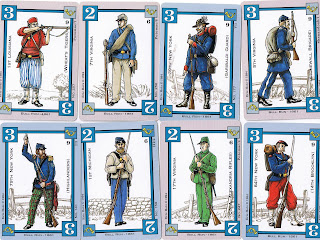
One of the more interesting things from a wargamers point of view is the OB and uniform information contained in the game. The entire order of battle of both armies is included in the game, with illustrations of all the regimental uniforms. Bull Run was the first battle of the war and both armies were much more colorful than they would be later on.


Some examples:

There are federal units in gray, rebels in blue and other combinations galore.

Dixie is definitely a wargamers kind of collectible game. It's got the kind of collectibility that should appeal to wargamers -- uniforms and OB while avoiding the kind of annoying collectibility found in many other CCGs such as promo cards, ultra rares and the like.

And if you don't want to do it the hard way, Columbia also offers a one-with-everything set that skips the whole random box scene.

The basic game is a good, introductory level tactical battle game that may appeal to the non-wargaming friends. The large cards highlight the kind of visual attractiveness usually seen in miniatures game and it avoid hexes and other wargamey conventions in favor of a very intuitive right-center-left battlefield.

Friday, January 2, 2009

Current wars engender surprisingly little wargame attention

One of the surprising things to me about the current state of the wargame hobby is the lack of attention to current contingencies.

Back in the 1970s and 1980s during the peak of the wargame hobby back then there was no shortage of games that dealt with actual contemporary military actions or the recent past. One of the early S&T games was Grunt, which depicted Vietnam combat even as fighting was still going on. Year of the Rat came out just a few months after the 1972 campaign it depicts. At least one Arab-Israeli wargame had to be redesigned because the 1973 war broke out just before publication. Test of Arms was published while some of its campaigns were still in the news. And, of course, the whole NATO vs. Warsaw Pact was an unending source of games until 1990. Even the first Gulf War prompted a batch of real-time depiction and immediate post-war titles.

In contrast, despite the fact that we're currently fighting TWO wars, there's very little to show for it. The initial march on Baghdad phase generated a little bit of action, such as Back to Iraq, but almost nothing since. Likewise the Afghanistan fighting hasn't provoked much in the way of wargame design, not even at the skirmish or tactical level. Where's the Grunt! for 2009?

Thursday, January 1, 2009

Last Game of the Year: Monopoly

Gathered the family unit for the "Official Last Game of the Year." We were going to nominate and dice for the result until Mom announced she'd play if the game was Monopoly, so the prospect of mom playing brought out the old classic by acclamation.


We played using the tin-box deluxe anniversary set.


Given the wide disparity of ages and experiences the official game poobah (me) made a couple of house rulings. The first was that we'd only play until the second bankruptcy (to avoid the dreaded drawn-out end game death throes) . I chose the second bankruptcy just to make sure some fluke bankruptcy by one of the young players didn't end the game prematurely. The second house rule was to spot the younger players some extra cash in order of age, youngest with the most $500. Mom insisted on her cut of the 'youth' bonus, so she got $5.


There were seven of us, ranging from youngest daughter 5, first-grade daughter, fourth-grader son, pre-teen daughter's friend, pre-teen herself, mom and poobah.

With seven players it was hard for anyone to quickly build up a property group and Boardwalk-owning pre-teen's covetousness of first-grader's Park Place provided quite a bit of drama as she tried to cajole sis out of her blue property, Unfortunately her reputation preceded her and little sis may not have understood exactly why she should sell to big sis, she knew big sis well enough to know if she wanted it so badly it couldn't be a good thing. Generally nobody was all that willing to trade much, being content to cruise around the board collecting small rents. Grand Poobah had been lucky enough to land on two RRs and bought a third from son during a slight cash-flow problem. Pre-teen also eventually ran into a cash shortage and offered it to Poobah as well.

In game with no property groups, having the four Railroads makes you the top dog. And with six other players on the board there was a steady stream of income coming in.

The game was starting to drag a bit, though, so Poobah decided to try to break things open. Flush with cash he was able to offer very attractive terms to the two separate owners of Mediterranean and Baltic (like five times the purchase price). It doesn't cost much to build up those properties and now there Hotels on the board. This juiced things up as everybody but the littlest realized that they needed to get a property group developed. Only son and pre-teen daughter were successful , but in both cases it cost them so much to purchase the land they could barely afford more than a house or two. (First Grade little sis was finally persuaded to give big sis her blue for $1,000 when mom assured her that it actually was a good deal for her).

As it turned out, Poobah's head start was too much to overcome as the Railroads kept pumping in cash and a couple of visits to his hotels drained competitors of cash they needed for construction. Finally pre-teen sis readjusted her goals and decided her new goal was NOT to be bankrupted out of the game and make sure she had more money than her friend at the end, so she offered to sell her barely developed blues to Poobah for $1,500 in walking around money rather than risk landing on a hotel and being bankrupted out of them anyway. Poobah obliged and immediately built up those properties to the max.

Pre-teen's new strategy soon succeeded as her mom and her friend both bankrupted out in short order, bringing the game to a merciful close.

Poobah's railroad wealth was evident as he ended up with more than $11K at the end of the game. The only other surviving player with a profit was First Grade sis, who had more than $2.

Everyone had a good time. Making a couple of house rules can fix some of the game's potential downsides for family play. When the playersget a little older no doubt more competitive urges will kick in.

Game review: Mason-Dixon

Mason-Dixon is an unusual what-if hex-and-counter wargame that assumes the Confederacy won the Civil War in 1863. The game background postulates that the two countries remain hostile and fight three more wars in 1917, 1940 and 1990, using technology comparable to actual history's World War I, World War II and Gulf War.

In a departure for XTR, the game does not use some variation of its standard wargame mechanics, but introduces a unique design. The game designer, Chris Perello, said he felt this was necessary because of the immense distances involved. Perello points out that the campaign area consists of more territory than the Eastern Front of the World Wars without anything like the unit density seen in Europe. This creates a situation more mobile than seen in each war (although the 1917 scenario is less mobile than 1940 or 1990).

Every month is divided into three player turns, each with a movement and combat phase. So far, so ordinary, but there are many unusual touches in those movement and combat phases which make for a very different game.

For example, one unique rule is entitled "Positional Advantage," which allows victorious attacking units to enter the defender's hex and acquire a positional advantage counter. In their next turn the defenders can leave or must counterattack. If the attacking units are still in the hex with a positional advantage marker on their next movement phase that positional advantage is converted into a "pocket" and the defenders are considered surrounded.

Another other unique rule is combat. While using an odds-based CRT, the combat resolution system is very different from the usual Command approach. First off, the number of dice rolled by the attacker varies from 1-3 depending on the amount of preparation and support. The fewer the dice, the better for the attacker. Many of the better results can only be achieved if the attacker is using one of two dice. The number of dice depends on things such as supply and artillery support.

The combat results are also different, especially the various kinds of exchanges (AX: Attacker Exchange; HX: Half Exchange; EX: Exchange; LX: Low Exchange and SX: Super Exchange -- all of which together probably set some record for the number of different kinds of exchanges in a wargame.) Besides the five different kinds of exchanges there are six other possible results, including No Effect.The exchange resolution system proved to be hard for many players to wrap their heads around, because counter intuitively, many times one side or the other might not actually lose anything. The key thing is to recognize that a force has to lose the most it can under the result, but never more than the result requires. So, for example, if two weak (2-factor) units defending in a hex suffer a LX (Low Exchange) they are both eliminated ("the defender loses one step from each participating unit") but if the attacking force was a pair of 5-factor attackers, they would have no loss. )"the attacker must lose steps whole total strength is less than or equal to half the defender's combat strength") Because both attackers are 5s they could not lose a step without it being MORE than half the defender's loss -- so the attacker loses nothing! If, on the other hand, the attackers had consisted of two 4-factor units and a 2-factor unit, then the attacker would have lost the 2-factor piece. Some players can have trouble believing what the rules say because it's so different from usual wargame practices. Basically the effect of the rule is to protect stronger units from exchanges they would suffer under more typical systems.

The heart of the game is the three different scenarios. Units are different for all three scenarios, although one annoying aspect is that many units are backprinted with units from different scenarios, sometimes even units from the other side! This makes it just about impossible to rationally sort the pieces. This will increase set-up time.

How long the game goes depends on the scenario, The 1995 scenario lasts 15 or 16 turns (every turn represents 2-days in the 1990s only). The 1917 and 1940 scenarios last until the "economy" of one side or the other is reduced to zero. The economy, which supplies resource points to mobilize new units and replaced eliminated ones, is recorded on a track. Losing cities costs points as does the passage of time. On die roll of a 1-4 one point is lost on the track to do war weariness. This is one rule I would recommend changing, as the effect is to shorten the game to the point where it's not possible to mobilize most of each army. The experience of the 20th Century was that war weariness in a major war does not set in for several years. In the First World War the French and Russians fought on until 1917 until mutiny and revolution occurred. The Germans didn't lose heart until 1918. In World War II only the Italians surrendered short of conquest. I think the game is more interesting if you don't start the war weariness loss until the second year of fighting, at least. The game includes such an interesting order of battle, most players are going to want the chance to play with most of it. In addition, the fronts are so vast that both sides will need some time for their strategies to mature.

Recommendations:

(Yes) for Wargamers: An interesting game in both topic and strategic possibilities. Even jaded wargamers will find this a fresh experience.

(Yes) for Collectors: Unique

(No, no) for Eurogamers: Too complicated, really.