There have been dozens of games about the Battle of the Bulge, the Battle of Gettysburg and the African Campaign -- but there's only been one Balkan Hell.
One of the more bizarre game topics ever covered in a professionally published wargame, Balkan Hell, one of two issue games in Command Magazine No. 35 (the other was Mason-Dixon) depicts a what-if campaign in 1995 IF the peace talks that ended the fighting had not taken place. For such an obscure topic the game has a very detailed order of battle for the various Balkan "armies" involved. One can only assume designer Ty Bomba had worked up an OB expecting the fighting to go on and decided to go ahead with the design anyway.
What you get is actually a pretty substantial game, with more than 300 5/8-inch counters, depicting five different armies. One one side are the Bosnian Muslim in green, Croat Bosnians in grey and Croatia in black. The other side sees the Bosnian Serbs in red and the "Yugoslavs" (really Serbs) in white.The 11-page rulebook describes a hex-and-counter wargame of low- to medium-complexity using standard attack-defense-movement factor units with regular wargame mechanics. The main twist is the turn sequence.
The Muslim/Croat side moves and then attacks, while the Serb/Yugoslav attack and then move. This provides the Croats with more offensive flexibility. However, as a further wrinkle, the Serb/Yugoslav side has a mechanized movement phase inserted between the Croat/Bosnian movement and combat phases. This allows them to reinforce points under attack and/or move mechanized units into position to join combats in the subsequent Serb/Yugo combat phase.
The one scenario is fairly open ended, as both sides are somewhat intermixed and will have opportunities to attack and defend. Victory is determined by how many victory points the Bosnia/Croat side has at game end. The game ends on turns 7, 8 or 9, depending on a die roll.Most victory points come from occupying cities and towns. Sarajevo is worth 15, other cities are worth 5 and the various towns are worth 1 point each. The Bosnians start in control of 91 VPs and need 121 or more to win. The Serbs win if the VP total is 115 or less, while a score of 116-120 is a draw.
The Bosnians can also score points for eliminating Serb artillery units, breaking the seige of Sarajevo and opening Highway 73.The Bosnian/Croat side also has a sudden death victory condition of controlling all the cities and towns in Croatia plus everything west of (Croatian President) "Tudjman's Line."Combat is resolved on the usual XTR step-loss/retreat CRT.Marring the game is a map graphics mistake that makes it hard to play. The green hatching used to depict "roadless" hexsides (which are impassible to mechanized units) is too subtle to stand out compared to the green used to depict the hill hexes (where all the roadless hexsides are, naturally). Except under very bright lights these hexsides are indistinct from normal viewing distances and players may need to use a marker to darken them.
Recommendations:
(Yes) for Wargamers: An unusual topic, with interesting strategic problems for both sides.
(Yes) for Collectors: The only game on the topic, and likely to remain so.
(No) for Eurogamers: Way too obscure a topic to bother with for a game what is otherwise an unabashed classic hex-and-counter wargame.
Tuesday, January 6, 2009


Reviewing collectible games from a wargamer's perspective: Dixie Shiloh
Dixie: Shiloh is the biggest set of cards in the Columbia Games stable of collectible card games. For the larger battles of Gettysburg and Waterloo the basic unit size represented by the cards was changed from regiment to brigade, although the illustrations still picked one regiment to represent the unit.
In Shiloh, though, the basic units are still infantry regiments, providing an illustrated order of battle that will definitely appeal to wargamers, although from a game player's point of view most of the units are functionally identical.
Like the other games in the Dixie series, the interaction between players and cards is minimal and the game is actually an abstract tactical battle game. The vast majority of cards represent units of infantry, artillery and cavalry or the generals leading them. Combat is resolved by units "firing" or "meleeing" against each other, with the number of dice rolled being equal to the card's combat value and the effectiveness of that fire depending upon the type of unit and the range of the fire. For example, a 3CV field artillery unit firing at "F1" rolls three dice with each roll of "1" inflicting a hit.
At the beginning of their own turn units that have suffered hits make a morale check, routing out of play if they roll higher than their CV, modified for terrain and leadership.
Dixie: Shiloh is different from the other games in the series because of the unusual nature of the battle. First off, instead of both sides setting up opposite each other in their own left-center-right sectors as in the other games, in Dixie: Shiloh the federal player sets up in all six sectors to start, which are labeled front left-center-right and back left-center-right respectively. All the Confederate units start in the CSA reserve position and have to fight their way onto the battlefield. The CSA wins by occupying the center back sector by the end of the first day (which ends when all CSA reinforcements have been drawn). If they fail, then a second day's battle is fought with the USDA winning if it captures the front center sector, making Dixie: Shiloh the one Dixie/Eagles series game where a draw is possible.
One new rule introduced in Dixie: Shiloh is a "stacking bonus" for leaders, which makes these gentlemen even more useful than before.
There are also some special cards adding some historical flavor such as "Johnny Shiloh" and the gunboats USS Lexington and USS Tyler.
Some sample cards:

The other Dixie games offer an option for playing a larger, 5-position battle but Shiloh is restricted to just the 3-position, 2-day battle. This is unfortunate because it means that only a small fraction of the available cards will be used in any game. With 400-500 build points and decks of just 200-250 cards, players can use the majority of their cards in Dixie: Bull Run and Dixie: Gettysburg, but Dixie: Shiloh, while having 400 cards, only has a 225-300 build point version. One way around this would be to simply double the build points and the stacking limits (including leaders stacking bonus) in order to sue more cards.
Like the other Dixie series games, Dixie: Shiloh is definitely recommended for wargamers. The OB alone is a pretty neat feature. Like the other Dixie games there is no artificial "rarity" factor to complicate collectibility. Also, like the other Dixie games, Columbia offers a one-with-everything set for those who don't want to bother with the random booster collectible scene.
Monday, January 5, 2009
Reviewing collectible games from a wargamer's perspective: Dixie Bull Run
Columbia Games was actually one of the first companies to jump on the Collectible Game bandwagon, publishing Dixie" Shiloh in 1994.
On the other hand, Dixie wasn't a whole-hearted CCG in the form we've become accustomed to over the years.
For one thing, the game eschews the whole rarity thing. While randomly sorted for packaging, all the cards are equally rare (or common). This made collecting a full set somewhat less daunting. In addition, there aren't really a lot of different kinds of cards. The vast majority of the cards are infantry with "combat values" of 1 to 4. Most of the balance of the cards are leaders and artillery, with a handful of cavalry units. There are a few terrain cards and 23 "special" cards, which are the only ones "played" to affect various game functions. All the generals, infantry, artillery and cavalry cards are used to maneuver and fight on a notional battlefield divided into left, center and right sectors for each army.
Indeed, the combat system is basically a copy of the tactical battle board system used in Bobby Lee and similar to the tactical system of Napoleon.
As such this game is very familiar territory for wargamers. Deck construction is fairly straightforward. There are no killer card combos or any such considerations. Instead the player uses the available battle points to select a mix of cards. Both sides deploy their initial "muster" on the board with any additional cards arriving as reinforcements.
Players can "fire" their guns cross the "middle ground at the op[posing array and send infantry and cavalry units across the "middle ground" in an attempt to seize the enemy's home sectors. If an army captures two out of the three enemy home sectors they win.
Combat in all cases involves rolling as many dice as the unit;s combat value, with the effectiveness of that fire depending upon the type of unit. For example, infantry units fire at "F2" which means a die roll of 1 or 2 hits. For every hit a unit has taken it has to make a morale check at the beginning of its next turn If it rolls more than its CV, modified for any leadership, then it "routs" and is removed from play.
As one can see, larger CV units are doubly powerful, rolling more dice and having a greater chance of passing a morale check. On the other hand, they are also somewhat fragile, in a case of having all ones eggs in a single basket. A single hit followed by a bad die roll can make a 4CV unit run away, wheres it would take 4 hits to clear out four 1 CV units (with a chance that a lucky roll may save one.) Leaders tend to benefit poorer units more. A single 0/1 leader can double the chances that 1CV units will hold their ground defending a position.
Compared to most card games there is very little card interaction between players. Only a couple of special cards can be played to directly affect the opponent's cards (Uniform Confusion, Rebel Yell). No, this is very definitely a wargame, albeit on the abstract side.
One of the more interesting things from a wargamers point of view is the OB and uniform information contained in the game. The entire order of battle of both armies is included in the game, with illustrations of all the regimental uniforms. Bull Run was the first battle of the war and both armies were much more colorful than they would be later on.
Some examples:
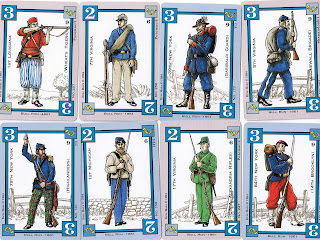
There are federal units in gray, rebels in blue and other combinations galore.
Dixie is definitely a wargamers kind of collectible game. It's got the kind of collectibility that should appeal to wargamers -- uniforms and OB while avoiding the kind of annoying collectibility found in many other CCGs such as promo cards, ultra rares and the like.
And if you don't want to do it the hard way, Columbia also offers a one-with-everything set that skips the whole random box scene.
The basic game is a good, introductory level tactical battle game that may appeal to the non-wargaming friends. The large cards highlight the kind of visual attractiveness usually seen in miniatures game and it avoid hexes and other wargamey conventions in favor of a very intuitive right-center-left battlefield.
Friday, January 2, 2009
Current wars engender surprisingly little wargame attention
One of the surprising things to me about the current state of the wargame hobby is the lack of attention to current contingencies.
Back in the 1970s and 1980s during the peak of the wargame hobby back then there was no shortage of games that dealt with actual contemporary military actions or the recent past. One of the early S&T games was Grunt, which depicted Vietnam combat even as fighting was still going on. Year of the Rat came out just a few months after the 1972 campaign it depicts. At least one Arab-Israeli wargame had to be redesigned because the 1973 war broke out just before publication. Test of Arms was published while some of its campaigns were still in the news. And, of course, the whole NATO vs. Warsaw Pact was an unending source of games until 1990. Even the first Gulf War prompted a batch of real-time depiction and immediate post-war titles.
In contrast, despite the fact that we're currently fighting TWO wars, there's very little to show for it. The initial march on Baghdad phase generated a little bit of action, such as Back to Iraq, but almost nothing since. Likewise the Afghanistan fighting hasn't provoked much in the way of wargame design, not even at the skirmish or tactical level. Where's the Grunt! for 2009?
Thursday, January 1, 2009
Last Game of the Year: Monopoly
Gathered the family unit for the "Official Last Game of the Year." We were going to nominate and dice for the result until Mom announced she'd play if the game was Monopoly, so the prospect of mom playing brought out the old classic by acclamation.
We played using the tin-box deluxe anniversary set.
Given the wide disparity of ages and experiences the official game poobah (me) made a couple of house rulings. The first was that we'd only play until the second bankruptcy (to avoid the dreaded drawn-out end game death throes) . I chose the second bankruptcy just to make sure some fluke bankruptcy by one of the young players didn't end the game prematurely. The second house rule was to spot the younger players some extra cash in order of age, youngest with the most $500. Mom insisted on her cut of the 'youth' bonus, so she got $5.
There were seven of us, ranging from youngest daughter 5, first-grade daughter, fourth-grader son, pre-teen daughter's friend, pre-teen herself, mom and poobah.
With seven players it was hard for anyone to quickly build up a property group and Boardwalk-owning pre-teen's covetousness of first-grader's Park Place provided quite a bit of drama as she tried to cajole sis out of her blue property, Unfortunately her reputation preceded her and little sis may not have understood exactly why she should sell to big sis, she knew big sis well enough to know if she wanted it so badly it couldn't be a good thing. Generally nobody was all that willing to trade much, being content to cruise around the board collecting small rents. Grand Poobah had been lucky enough to land on two RRs and bought a third from son during a slight cash-flow problem. Pre-teen also eventually ran into a cash shortage and offered it to Poobah as well.
In game with no property groups, having the four Railroads makes you the top dog. And with six other players on the board there was a steady stream of income coming in.
The game was starting to drag a bit, though, so Poobah decided to try to break things open. Flush with cash he was able to offer very attractive terms to the two separate owners of Mediterranean and Baltic (like five times the purchase price). It doesn't cost much to build up those properties and now there Hotels on the board. This juiced things up as everybody but the littlest realized that they needed to get a property group developed. Only son and pre-teen daughter were successful , but in both cases it cost them so much to purchase the land they could barely afford more than a house or two. (First Grade little sis was finally persuaded to give big sis her blue for $1,000 when mom assured her that it actually was a good deal for her).
As it turned out, Poobah's head start was too much to overcome as the Railroads kept pumping in cash and a couple of visits to his hotels drained competitors of cash they needed for construction. Finally pre-teen sis readjusted her goals and decided her new goal was NOT to be bankrupted out of the game and make sure she had more money than her friend at the end, so she offered to sell her barely developed blues to Poobah for $1,500 in walking around money rather than risk landing on a hotel and being bankrupted out of them anyway. Poobah obliged and immediately built up those properties to the max.
Pre-teen's new strategy soon succeeded as her mom and her friend both bankrupted out in short order, bringing the game to a merciful close.
Poobah's railroad wealth was evident as he ended up with more than $11K at the end of the game. The only other surviving player with a profit was First Grade sis, who had more than $2.
Everyone had a good time. Making a couple of house rules can fix some of the game's potential downsides for family play. When the playersget a little older no doubt more competitive urges will kick in.
Game review: Mason-Dixon
Mason-Dixon is an unusual what-if hex-and-counter wargame that assumes the Confederacy won the Civil War in 1863. The game background postulates that the two countries remain hostile and fight three more wars in 1917, 1940 and 1990, using technology comparable to actual history's World War I, World War II and Gulf War.
In a departure for XTR, the game does not use some variation of its standard wargame mechanics, but introduces a unique design. The game designer, Chris Perello, said he felt this was necessary because of the immense distances involved. Perello points out that the campaign area consists of more territory than the Eastern Front of the World Wars without anything like the unit density seen in Europe. This creates a situation more mobile than seen in each war (although the 1917 scenario is less mobile than 1940 or 1990).
Every month is divided into three player turns, each with a movement and combat phase. So far, so ordinary, but there are many unusual touches in those movement and combat phases which make for a very different game.
For example, one unique rule is entitled "Positional Advantage," which allows victorious attacking units to enter the defender's hex and acquire a positional advantage counter. In their next turn the defenders can leave or must counterattack. If the attacking units are still in the hex with a positional advantage marker on their next movement phase that positional advantage is converted into a "pocket" and the defenders are considered surrounded.
Another other unique rule is combat. While using an odds-based CRT, the combat resolution system is very different from the usual Command approach. First off, the number of dice rolled by the attacker varies from 1-3 depending on the amount of preparation and support. The fewer the dice, the better for the attacker. Many of the better results can only be achieved if the attacker is using one of two dice. The number of dice depends on things such as supply and artillery support.
The combat results are also different, especially the various kinds of exchanges (AX: Attacker Exchange; HX: Half Exchange; EX: Exchange; LX: Low Exchange and SX: Super Exchange -- all of which together probably set some record for the number of different kinds of exchanges in a wargame.) Besides the five different kinds of exchanges there are six other possible results, including No Effect.The exchange resolution system proved to be hard for many players to wrap their heads around, because counter intuitively, many times one side or the other might not actually lose anything. The key thing is to recognize that a force has to lose the most it can under the result, but never more than the result requires. So, for example, if two weak (2-factor) units defending in a hex suffer a LX (Low Exchange) they are both eliminated ("the defender loses one step from each participating unit") but if the attacking force was a pair of 5-factor attackers, they would have no loss. )"the attacker must lose steps whole total strength is less than or equal to half the defender's combat strength") Because both attackers are 5s they could not lose a step without it being MORE than half the defender's loss -- so the attacker loses nothing! If, on the other hand, the attackers had consisted of two 4-factor units and a 2-factor unit, then the attacker would have lost the 2-factor piece. Some players can have trouble believing what the rules say because it's so different from usual wargame practices. Basically the effect of the rule is to protect stronger units from exchanges they would suffer under more typical systems.
The heart of the game is the three different scenarios. Units are different for all three scenarios, although one annoying aspect is that many units are backprinted with units from different scenarios, sometimes even units from the other side! This makes it just about impossible to rationally sort the pieces. This will increase set-up time.
How long the game goes depends on the scenario, The 1995 scenario lasts 15 or 16 turns (every turn represents 2-days in the 1990s only). The 1917 and 1940 scenarios last until the "economy" of one side or the other is reduced to zero. The economy, which supplies resource points to mobilize new units and replaced eliminated ones, is recorded on a track. Losing cities costs points as does the passage of time. On die roll of a 1-4 one point is lost on the track to do war weariness. This is one rule I would recommend changing, as the effect is to shorten the game to the point where it's not possible to mobilize most of each army. The experience of the 20th Century was that war weariness in a major war does not set in for several years. In the First World War the French and Russians fought on until 1917 until mutiny and revolution occurred. The Germans didn't lose heart until 1918. In World War II only the Italians surrendered short of conquest. I think the game is more interesting if you don't start the war weariness loss until the second year of fighting, at least. The game includes such an interesting order of battle, most players are going to want the chance to play with most of it. In addition, the fronts are so vast that both sides will need some time for their strategies to mature.
Recommendations:
(Yes) for Wargamers: An interesting game in both topic and strategic possibilities. Even jaded wargamers will find this a fresh experience.
(Yes) for Collectors: Unique
(No, no) for Eurogamers: Too complicated, really.
Tuesday, December 30, 2008
Been under the weather
Hence the sparse posts of late. With luck it will back to full steam ahead shortly
Friday, December 26, 2008
Reviewing collectible games from a wargamer's perspective: INWO
Illuminati: New World Order is an odd fish in many ways, starting with the theme, of course.
The basic premise is that all those tinfoil-wearing conspiracy theorists are right and there really are unseen powerful secret groups manipulating world events.
In the game this manifests itself with players constructing decks made up of two basic kinds of cards: Groups, which the player is trying to control or destroy, and Plots, which are the tools used to help get control, destroy or defend groups.
The game is heavily satirical and explicitly not Politically Correct, although all groups, ideologies and cultures are mocked equally.
Also making the game an odd duck is its status. Is it dead, alive or something in between?
On the one hand, it's a member of the Class of 1995 first wave of CCG's that came out after Magic: The Gathering was recognized as having created a whole new genre of games. Only a handful of games from that era survive, although M:TG is going strong.
On the other hand, INWO is still available from Steve Jackson Games, the original publisher, which would seem to qualify it as "alive."
But on yet another hand, there hasn't been anything new published for about a decade, which implies a certain like of vitality, to say the least.
However you characterize it, the current state of INWO means that it avoids some of the more annoying aspects of CCGs. No cards have become obsolete. There is a finite set to collect and yet there's always the possibility some new cards will show up.
The M:TG-style collectibility is further undermined by Steve Jackson's less than wholehearted support of the concept. Yes, he admittedly jumped on the bandwagon, by his own account, but never went whole hog. There were very few promo cards and no ultra rares. There are at least two ways to buy into the game while by-passing the whole collectible aspect. SJG offers a "One-with-everything factory set" that includes all the first edition cards. There is also the INWO Subgenius (which is even more weird than INWO) which is a completely standalone 100-card INWO game but also fully compatible with the regular INWO.
Players build a conspiracy structure based on their particular variety of Illuminati (UFOs, Bemuda Triangle, Bavarian Illuminati, etc.) trying to meet their goal. This can involve controlling a certain number of groups, but can also involve destroying groups or meeting other special victory conditions. The available groups run the gamut from personalities such as Bill Clinton, countries such as Canada, organizations such as the CIA or even loose groups of like-minded folks like wargamers!.
As a multi-player game INWO is best played with a group, but the off-beat theme may make it hard to find a group that are all interested in playing it. I think a wargaming group may be willing to try it, it is after all, a game of conquest, but is is not really a game of maneuver. There's a lot of strategy in it but it tends to be more Sun Tzu or Machiavelli than Clausewitz or Napoleon.
The game is, as I noted, still available from Steve Jackson Games, but players can also pick up cards off of eBay on a regular basis. Casual players who want to try the game out can either buy the Subgenius expansion or the regular Illuminati non-collectible card game, which plays much the same.
Wednesday, December 24, 2008
Rare night out eurogaming
Due to my job I rarely have a weekday evening off, and when I do have one off it's usually for some non-gaming reason, so I don't normally have an opportunity to game with the nice folks down New Haven who "Fell Like A Kid Again" in their Meetup Group.
But yesterday I did have such an opportunity and I had a grand old time.
I had the chance to play two games I've had my eye on for some time, but it's been my policy lately to avoid buying games until I've had a chance to play them, with a few exceptions.
We started off the evening playing Winning Circle, which is sort of a Reiner Knizia version of Win, Place & Show, which is to say that it captures most of the best parts of the older game while being a far more elegant and efficient design. I managed to avoid coming in dead last in the 6-player game, but I did have a lot of fun and I resolved to pick up a copy when I get the chance. My kids like Win, Place & Show but it's a little complicated for them and it takes a pretty long time to play. While Winning Circle certainly has sufficient strategy for them to grow into, the basic structure is simple enough that they can still enjoy playing even if they haven't yet developed a sense of strategy. It also plays considerably faster.
Our second game was another one I've been thinking about for a while: Jamaica. In this case the name of the game is a big selling point, given my deep connections with that island. On the other hand, while a Caribbean pirate-themed game, it doesn't really have much to do with pirates and even less to do with the actual island of Jamaica. It's really another race game, although like Winning Circle it s extremely nicely done and involves rather more strategy than one might suppose. I did come in dead last in this one in a three-player game. While I enjoyed it, I'm less certain about buying a copy of this one, mostly because it's really a game for grownups without as much appeal for the kids. If my schedule starts to allow some regular gaming with bigger folks I'd consider having a copy, but in the meantime I'll probably hold off.
Still, the entire evening was exceptionally enjoyable. Everyone was very friendly and the venue, a small retail store, a perfect site.
Monday, December 22, 2008
Reviweing collectible games from a wargamer's perspective: Redemption
Redemption is a case of a collectible game that has some of the trappings of a military conflict game, but is really of limited interest to wargamers.
This bible-based card game was part of the first major wave of collectible games to hit the market in 1995 after Magic:The Gathering pioneered the concept. Unlike most of those 1995 games, however, Redemption has managed to stay in print all these years. While not a bad game, by any means, the relative success and longevity of Redemption has more to do with its appeal to a particular niche of the market -- the Christian (especially evangelical) market. While the game is non-denominational enough to appeal to any Christian belief and, indeed, could appeal to many secular-minded people as well, it's main reason for existing is the reality that there's a market for Christian themed products of all sorts for people who feel the wider secular popular culture has a lot of problematic elements from a moral stand point. There's an entire subculture of books, magazines, music, plays, television programs, movies and many other products oriented towards Christians that are largely invisible to the wider public.
While Magic: The Gathering was wildly popular, it posed a problem for Christian parents and teens because its full of topics most Christians find highly suspect, such as magic, evil characters placed on the same level as good, sacrifice and abominations of all sorts. So to provide an alternative that provided a more wholesome message while providing many of the same gaming experiences as M:TG Redemption was created.
The basic premise of the game is that heroes are being sent into the land of bondage to rescue lost souls. These heroes are opposed in their quest by Evil Characters. The Heroes and Evil Characters engage in a test of strength, comparing attack and defense strengths (in a diceless system similar to Magic: The Gathering). Both sides can be enhanced with cards and, as one might expect, there are various special cards that can be played as well. The cards are very attractive, with Biblical passages related to the card's theme and quality illustrations.
All the cards are based on events, people and themes from the Bible and it turns out to be a surprisingly rich source. There are even dragons!
Even though the game does include many warlike or military-sounding things such as bow and arrow, buckler and David's Sling there are also many decidedly unwarlike enhancements as well such as Gentleness, Joy, Shoes of Peace and the Submissiveness of Mary.
From a wargamer's point of view, the game is of limited interest, having little to do with military tactics and strategy. As with most CCG's card-playing skills such as hand-management and combo-building are more important than skills based on the traditional principles of war.
On the other hand, it's an accessible game that succeeds in providing an entertaining Christian-themed CCG. It's a somewhat easier game than Magic: The Gathering, making it easier to teach to non-gamers and younger children, but I think there's sufficient detail that deck building will still be interesting for experienced players. New expansions for the game come out about every two years or so, so the game is nowhere near the money sink that M:TG is. The company's Web site provides tournament materials, but there's little evidence of a strong tournament scene for the game.
I don't think most wargamers would seek this out, but if you happen to be a wargamer who also has an interest in Biblical themed games then I think you may find it of some interest.
Sunday, December 21, 2008
Rommel at Gazala review
This is the issue game in Command Magazine No. 34 (which also included the Death & Destruction expansion for Proud Monster).
Dwarfed by the D&D expansion, Rommel at Gazala would be easy to miss, with less than 100 5/8-inch counters.
The game uses the system that debuted in Budapest '45, which uses unit rosters to track step losses. Compared to other step-loss games, the units here have a large number of steps, often 20 or more. The rosters list the attack and defense factors of the unit. Movement allowances are determined by unit type. The only information on the counter itself, aside from from its nationality color and NATO unit symbol, is the unit's historical ID. The unit rosters and step losses are less work in Rommel than they were in Budapest because of the extremely low unit density. There are just a dozen Axis units, and less than two dozen Allied ones. Axis units are divisions, except for two Italian regiments and one German brigade. Allied units are brigades.
With so few units the placement of each one becomes critical. As in Budapest '45, when units are not in combat they are kept face down. In Rommel, because there are so few units, this limited intelligence will have little effect, especially for the British. The lion's share of the Axis offensive power is contained in the three German mobile divisions, which the Allied player should have no problem tracking from memory (the rules prohibit taking notes) There's a little more scope for deception on the Allied side, although most brigades have comparable factors. The Axis can detach a recon battalion from each German mobile division to help cover more ground, but these one- or two-step units are very fragile and cannot be replaced if eliminated.
As in Budapest '45 the turn sequence is asymmetric. After a mutual supply check phase the Axis move their mechanized units. They conduct a combat phase and then all Axis units can move and clear mines.The British player turn consists of a combat phase followed by the movement/mine clearing phase, so just as the Soviets were in the earlier game the British are forced to set up their attacks the turn before executing them.
The map is based on the terrain analysis of the Moments in History wargame Triumphant Fox. Each hex is 3.5 kilometers, every turn is a day. The small unit scale for a divisional-level game is responsible for the inclusion of a zone of control rule, which is most unusual for XTR games. Units are forced to stop by enemy ZOCs and cannot move through them. They may, however, leave an enemy ZOC and combat is not required. Combat is odds based with step losses, as is usual in XTR games. Besides ZOCs there are very extensive minefields on the map, which also channel movement. Both sides can clear enemy minefield hexes during their general movement phases.
The winner is determined by victory points, with every eliminated step worth 1 VP, except for eliminated Italians, who net the British 2 VPs each. Should the German be so careless as to allow the British into hex 1200 (the coast road leading off to the West) they'll be giving up 50 VP.
The primary Axis objective is to capture Tobruk, which is worth a variable number of victory points, depending on the turn. The longer it takes the Germans to capture the port, the fewer VPs it's worth. On May 27, Turn 1 (an impossibility) it's worth 130 points. By June 21, Turn 26, it's worth 0 VP. If sufficiently ahead on points the British can declare a withdrawal, conceding Tobruk as of that turn, but escaping with all supplied forces and denying the Germans those VPs. As both sides keep their exact losses a secret, the British cannot slice this too closely or they could just cost themselves the game.
Set up time is minimal, with just a couple dozen pieces. The game is easily playable in a single session and fast movers can probably complete a two-game match in an evening.
Recommendations:
(Yes) for Wargamers: Especially for players who want to try out the Budapest'45 system.
(No) for collectors: Nothing notable here.
(Conditional no) for Eurogamers. If you're interested in checking out a hex-and-counter wargame this is meaty enough to be a good representative while the low unit density helps keep it manageable.
Thursday, December 18, 2008
Reviewing collectible games from a wargaming perspective: Echelons of Fury
Like it's sister game, Echelons of Fire, the 1995 collectible game Echelons of Fury was an obvious imitator of Magic: The Gathering, with a similar sequence of play, combat mechanism and overall approach.
From a wargamer's perspective the World War II-themed Echelons of Fury may have a little more interest than the modern-themed Fire version of the game, but the game is still afflicted with the same flawed card selection and underdeveloped rules as the modern game and will generally be as frustrating.
As with the Fire game, Fury is a quite dead, so acquiring cards will tend to be fairly easy and inexpensive, if one is so inclined. Drafting decks from a common collection can create some interest and playing a game won't take all that long in most cases. The game allows for varying the deck size and the resulting level of headquarters damage needed for victory, but I think the game is best played with the minimum 40-card and 20 point HQ. Under those conditions the game plays quickly and you can get a whole series of games completed in a short period of time. Restricting the deck so severely makes the card choices more intense.
My particular collection happens to have a "brothel" card, which is not only amusing but shows where the designer missed an opportunity to differentiate his game from Magic: The Gathering and prospered. A big problem with the Echelons game sis that they are, frankly, kind of dull and dry. Throughout the game there's evidence that keeping costs down was a priority but I think this came at the cost of its long-time viability.
The "Brothel" card adds some spice to the game but also indicates how the game could have kept interest fresh by mining some of the rich history of the vast conflict. For example, the game as printed suffers from an excess of identical common cards. Anyone who acquires more than a few decks worth will have far more regular infantry squads, light machine guns and bazookas than they could ever hope to use. But by simply labeling the cards with the names and histories of famous fighting units the collectibility and historical interest of the game could have been heightened. Perhaps a Squad from the Big Red One 1st Infantry Division and one from the Bloody Bucket 28th Infantry Division would have been the same in game terms, but they would have given players less reason to feel cheated when they opened a booster pack and got yet another coupe of common squads.
Likewise many more flavorful special events could have been brought into play with more creative cards like the Brothel card hinted at. World War II was full of strange and unusual events that could provide fodder for cool cards.
As it turned out, the collectible game market is fiercely competitive and there appears to only be room for a handful of hot titles at any given time. Without a hook that could help it stand out in the crowd Echelons of Fury joined Echelons of Fire in the bargain bins.
Had the game lasted longer it might have had time to work out some of the kinks in the game design. It's easy to forget today that many of the early Magic sets had some real problem cards and rules that led to some significant changes and left a legacy of banned and restricted cards. It's been a few years since Magic had to ban a card in play and I think this reflects the intense development process the company uses.
Players of Echelons of Fury will have to make their own fixes, but considering that all play will be among friends in casual play this should not be difficult.
Overall, I think Echelons of Fury is a mildly amusing light war-themed card game that would be worth getting on the cheap if you get the chance, but not anything you'll particularly miss if it passes you by.
Wednesday, December 17, 2008
Dollar slide may affect global gaming community
The dollar lost significant ground against the euro and yuan today: http://www.ft.com/cms/s/0/4460aa54-cc6f-11dd-acbd-000077b07658.html
This may impact the gaming world, especially U.S. gamers who like euro games and/or nice bits.
On the other hand, European gamers may find US products a bargain for a while, so long as they don't include too many Chinese-made parts.
I wonder if they'll be any repeats of anything like Axis & Allies: Anniversary Edition anytime soon. I'd expect a price increase for things like Axis & Allies miniatures or BattleLore as well.
Buying products from Europe is likely to become especially expensive as the dollar to euro ratio moves towards 2 for 1. Will people pay twice as much for a German game as they do now? On the other hand there may be some nice bargains the other way.
Reviewing collectible games from a wargaming perspective: Echelons of Fire
I've reviewed Echelons of Fire in greater detail elsewhere, http://www.boardgamegeek.com/thread/315273, but to recap, Echelons of Fire was one of the first wave of collectible card games to appear once Magic : The Gathering made its big splash. It's theme is modern era tactical level combat. Most of the cards are either United States Army or from the Soviet-style N.D.G. (I call them the No Darn Goods). The second edition added some British and Serbian units. The only dragons in this game are a U.S. anti-tank missile.
Echelons was a closer imitator of Magic than most. If it wasn't a clone, it was at the very least a half-sibling, sharing the same sequence of play and many of the same concepts, even including ante. Like Magic the game is won by reducing the enemy player (headquarters) from its initial 20 points down to zero points.
Echelons does have some differences from Magic that extend beyond mere names. Unlike Magic, for example, there is a limited form of maneuver in Echelons of Fire, as attacking units must use a maneuver card (left, center or right) to pass through a terrain card (woods, town, hills, open, city, bridge, river) on their way to the target headquarters.
Also somewhat different from Magic is the role of the supporting supply (mana) cards. In Echelons you not only have to pay the unit's cost in ammunition and fuel points to deploy it initially, you must keep paying it very turn. This is similar to the concept of "upkeep" in Magic, but it's a standard feature, not a special ability.
More so than Magic ,the fighting in Echelons revolves around the units (creatures in MTG terms) as there are relatively few ways to directly attack an enemy headquarters.
For a wargamer the theme in Echelons of Fire is obviously much more attractive than MTG. As Echelons is a "dead" game, there is no convention or tournament scene so casual play is the only available venue. Because the game is no longer in print there is a finite size to the collection and cards are inexpensive to obtain on eBay and still generally available.
There are some rules holes and "degeneracy" problems in the game that may have to be house ruled if you play a lot, but they probably won't come up among casual players with limited collections very often.
The quality of the cards is a notch below Magic and the breakdown between common, uncommon and rare cards is poorly done. Players will have vast numbers of common fire teams and infantry weapons in excess of any need. If you build up any sized collection at all you will even have plenty of the rare cards, which are much less overpowered than similar cards are in Magic.
My overall recommendation is that Echelons of Fire may be of mild interest to a wargamer. It allows you to explore some of the deck construction metagame of Magic without the expense and the frustration of facing players who have much more resources. Indeed, as you're not likely to find an opponent with his own cards, you'll probably be drafting both decks from your own collection.
It is still, fundamentally, a card game in mechanics and card-game skills will play a bigger role than the usual principles-of-war based maneuvering typical in board wargames. That said, it does adhere to the theme strongly, and wargamers will probably find it a more comfortable theme than Magic: The Gathering.
Monday, December 15, 2008
Reviewing collectible games from a wargaming perspective: Magic: The Gathering
Magic: The Gathering is one of the seminal games of the gaming hobby, right up there with Tactics, Diplomacy, Panzerblitz, Dungeons & Dragons and Settlers of Catan. It created an entirely new category of gaming, collectible games, when it came out in 1993, as as such, it's worth at least having a passing acquaintance with for any gamer.
And it has been very successful, being one of the few game designs to make it's designer a fortune. Although it's now more than 15 years old and and spawned several imitators and inspiring many other collectible games, it's never really been surpassed.
I think this is a testament to a very sound basic game structure that has proven to be very robust.
For those who don't know, the basic sequence of play is straightforward.
After starting with an administrative "upkeep" phase, a player draws a card and then plays cards during the "main phase." There are literally thousands of different cards, but two of the most common are "lands" and "creatures." A player can place one land into play per turn and then "tap" (use) that land and any previously played lands to generate points of "mana," which is the currency of the game. Mana comes in five colors and playing non-land "spell" cards costs varying amounts of mana in color specified on the card. One of the most common kinds of spells is one that summons various creatures. If a creature summoning spell makes it into play (there are cards that can head it off) then it becomes a creature with an attack and defense value. During the main phase a player can dispatch any creatures that have not just appeared to attack the opposing player. The defender can send his previously played creatures to block the attackers. Each fight is resolved by comparing the each attacking value to each defending value. No dice are involved. Unblocked creatures attack the opposing player costing him or her one point of "life" for every attacking point. Players start with 20 life points and are defeated when reduced to zero. After combat concludes, the main phase resumes, allowing the phasing player to play more spells, if desired.
All of these activities can be affected, modified, cancelled, enhanced, disrupted, etc., etc. and etc. by various cards and the timely playing of the cards is a big part of the game. Perhaps an even bigger part of the game is the pre-game deck-building activity, as a player selects from his available cards to create the most effective fighting force.
Because the game explicitly features combat between dueling foes, it bears a resemblance to wargames and might be expected to appeal to wargamers, or at least those open to non-historical themes.
There are, however, significant obstacles for wargamers who might think about dipping into the pool of Magic: The Gathering players.
Magic: The Gathering is more than just a game. It's a deeply absorbing hobby in itself. Indeed, in order to be a serious Magic player there's really little time, money or energy left for anything else. A wargamer who made a serious effort to get into Magic: The Gathering would, by definition, cease being a wargamer and would become a Magic player.
It's similar to the problem casual chess players face whenever they ponder getting "into" the serious chess world. The fact of the matter is that becoming a mediocre rated player, let alone a master-level chess player, takes dedicated effort and e=intense study. Magic is the same, but with an added dimension of cost. One simple illustration is looking at the top-rated tournament decks listed on the wizards.com Web site. Looking at several dozen of them one sees that there's hardly a basic land card in the bunch. Nearly all of them feature 20 or so specialty land cards which are more efficient in play, but also are in limited supply as rare cards. Acquiring the cards alone means buying many boosters or purchasing the cards as singles at a premium from dealers.
Fortunately there is an option for those who might want to try the game out without going crazy. Wizards of the Coast generally offers pre-constructed decks. For example, currently there is a duel set that pits two set pre-constructed decks against each other in one $20 package. This provides a way to have a fair game between two players and is roughly comparable in price and value to standalone non-collectible card games. While not usable for tournament play,. these decks can serve as a useful primer. Similarly, a more casual player can take part in the tournament scene by playing in "sealed draft" tournaments, where all the players have access to the same boosters and they draft cards to build their decks. Experienced players still have a significant edge in this format, of course, because of their better understanding of the game, but it's less pronounced than in constructed deck play.
One major advantage of Magic: The Gathering is that it is very popular and well-supported, so finding opponents is easy. There's hardly a burg big enough to have a post office that doesn't have a store offering Magic: The Gathering organized play within an easy drive.
Still, while I can see value in a wargamer picking up a couple of decks to try the game out, I can't recommend going much further than that. Playing Magic: The Gathering to a satisfying level of success will require such a big commitment that a player will probably have little time for anything else.
While featuring play that resembles combat, any prior wargame experience won't be all that useful because Magic is, at root, a card game, not a combat game. Knowing the Principles of War and being skilled at maneuvers or planning will be of little use. The hand-management skills of a good Poker player are much more relevant.
My overall recommendation is to dabble in Magic: The Gathering if you can restrain yourself from getting sucked into the maelstrom of organized play. It is a good game, basically, and worth having a couple of decks on hand for casual play when the mood strikes. If you're a competitive player , however, be forewarned that success requires going whole hog. You may have fun, but you'll be an ex-wargamer.
Thursday, December 11, 2008
The pros and cons of collectible game - a wargaming view
Over the next few weeks I plan to review some of the collectible games I'm familiar with from a wargaming hobby point of view.
By definition these will all be collectible games or have collectible-like features so rather than repeating this discussion for every review I thought it might be better to address the pros and cons of the collectibilty concept as it applies to the whole class.
I think there are several ways that collectibility affects a game system that will be important to the typical wargamer, who will generally have had little exposure to the concept unless he also has general game interests.
Wargames have heavily used the idea of expansions and expandability, of course. One of the very first SPI projects was the Blitzkrieg Expansion Module, which added all sorts of bells and whistles to Avalon Hill's Blitzkrieg and required possession of the original game in order to play.
The idea of a metagame involving army building goes back to at least PanzerBlitz and its optional point-based scenarios and competitive tournament play has always been a part of the board wargaming hobby since it reached a critical mass big enough to support conventions. And, of course, wargaming has always been a wallet-stripping hobby where there's persistent temptation to spend money on gaming stuff that you'll never end up actually playing.
Still, these various elements, which are peripheral to wargaming, all play a significantly enhanced role in the collectible game hobby experience.
For example, the money sink. As long as a collectible game is "alive," serious players are really required to sink a lot of money into that particular gaming line. While individual booster packs are relatively low priced in real terms (usually $10-$15, about the cost of a fast-food meal for two or a DVD) in the aggregate they add up to a significantly more expensive way to game than board wargaming and can even exceed the cost of a typical traditional miniature wargamer's budget. While $100 is a lot by board wargame standards and will usually buy you a big game like Axis & Allies: Anniversary edition, Tide of Iron or War of the Ring or let you buy a base game and at least one expansion like Memoir'44 or Combat Commander, for most collectible games it's just the down payment on a minimally competitive set.
In addition, "living" collectible games almost always have planned obsolescence for components as older sets get "retired" from official sanctioned play.
These aspects of collectible games generally make them unattractive to wargamers. Typically being a serious player of a collectible game will easily take up the entire game budget for most people. Buying just one or two boosters per week will add up to an annual cost of $700-$1,000. Spending much less than that will mean you can't expect to be competitive in sanctioned play.
There are, of course, ways to ease the financial strain, but no way to eliminate it. The simplest is to simply wait until the game "dies." While, in theory, a collectible game that goes out of print should remain just as playable as it was before, in practice going out of print generally means an end to sanctioned official play and a loss of interest among players. On the other hand, however, it usually means game elements are available for less in the secondary market and often mean the game will be in "bargain bins" in stores. It can be also be cheaper to fill out your constructed decks and warbands by purchasing the elements you need from online retailers, although the most desirable elements can be prohibitively expensive.
The whole collectibility concept is built around competitive play and the resulting metagame. This is not necessarily a drawback. The most active competitive playing venues in gaming are built around collectible games, with sanctioned tournaments every week in most areas. By contrast, competitive play for most board wargames is restricted to a couple of national conventions and a handful of regional cons. I don't think competitive play is a large motivation for wargamers, but for that smaller subset that wants it collectible games provide it in spades.
Even of it were not so expensive in money, collectible games are expensive in time. The largest part of the gamer's energy is expended in deck or warband construction. Building a competitive army will take a lot of thinking, studying and experimenting. This is, again, not necessarily a negative thing. If one counts the hours spent plotting, studying and thinking as part of the "playing" time than collectible games are not so expensive after all in entertainment value. This aspect of collectible games may be the most attractive to wargamers, who often enjoy that kind of "offline" game experience anyway. Most wargames are played solitaire, after all, with wargamers often studying their games intensely outside of playing time against an opponent.
To some extent all collectible games share these three characteristics: Cost, competition and consuming of time. For many wargamers any or all of these may make any collectible game a non-starter for them. But if not, then it's worth looking at the specific characteristics of a particular game to see if it's of potential interest for wargamers.
Wednesday, December 10, 2008
Death and Destruction module review
Death & Destruction is not a standalone wargame but an expansion module for Proud Monster, Ty Bomba's magnus opus divisional level Barbarossa game. D&D covers the next two years of the war, until the Spring of 1944.As a module, no fundamental changes are made to the game system and the 15-page rule book is all special rules to account for order of battle changes and other developments as the war moves out of its initial phases.
The counters include various later war reinforcements for both sides, although the Soviets naturally benefit the most as new, more powerful units appear such as more than 100 Guards units, mechanized corps, tank corps and sundry other good stuff to allow the Soviet side some fun kicking German panzers around after having been manhandled in 1941.
The largest group of German counters actually represents a decline in quality as all the infantry divisions go through a universal downgrade in 1943.
For Germans tempted by the allure of Caucasus oil there is an expansion Map C which is added if the Germans head in that direction.
The expansion also includes two turn record cards. a German Replacement Army roster and a card with other charts and tables related to the expanded game such as a guards conversion table and even a "Game Turn to Remember List." With as many as 68 turns of play possible, it's easy to see how that might be handy.
With this expansion, PM/D&D become a true "monster game." While with just two maps it's not physically the biggest Eastern Front wargame, but it may be one of the more playable. As an expansion, D&D does add some set-up time. If one plays the whole campaign it can obviously be a very long game, taking up more than 60 hours of playing time.
The game will not necessarily go the distance however. On certain specified turns the Germans check to see how many victory points (awarded for geographic objectives) they have. If it's within a certain range the game goes on, if it falls outside of it one side or the other loses.
UNLESS, of course, the players want to go on (which given the investment they have made in time and effort, would be tempting). In that case the winning side gets "forgiveness points" they can use later to score later.
The Germans also have an opportunity twice to bring the game to an early end by launching go-for-broke efforts for victory. One of these occurs in the Proud Monster portion and is discussed there. But in 1943 the Germans can declare "Manstein's Gambit." This gives them extra units but requires a victory on points by the time the weather turns bad that year, or the Soviets win.
One unusual rule in D&D is "mechanized upgrades" otherwise called "stuffers." These are counters representing extra steps that can be added to mechanized units. The unit's combat values are unaffected, but it can lose the extra steps before taking actual step reductions. This adds considerable staying power to the units so blessed.
Recommendations:
(Yes) for Wargamers: If you have Proud Monster
(Yes) for Collectors: Only if you have Proud Monster
(No) for Eurogamers: Why would you have Proud Monster?
Tuesday, December 9, 2008
Great War in Europe review
A lot of ideas that appear in Ted Raicer's popular Paths of Glory make an appearance here, with the game's chit random event system. Perhaps the most monstrous of the "mini-monsters" published in Command Magazine, The Great War in Europe, from issue No. 33, covers the major fronts of World War I on the divisional scale. Most turns are one or two months, except for August and September, 1914, where each turn is just two weeks. Each hex on the western and Italian fronts represents 9.5 miles, every hex on the Russian front is 22.5 miles. The different ground scales are handled by doubling every unit's movement allowance on the western front (so a 2-4 French infantry division is really a 2-8.).
Units are the standard attack-defense-movement factor layout. Where the attack and defense factors are the same -- as in the aforementioned French division -- a single combat factor is listed.
The core of the system (supply, movement and combat) only take up five pages of the 22-page rule book. Most of the rest is devoted to all the myriad of special rules needed for the chits and other special for neutrals, strategic moves, etc.
The most notable facet of the game, aside from the chit pull, is the initiative system, where whoever has the initiative on one front has to give it up on the other. For example, at the start of the game the Germans have the initiative in France (Italy is not yet active) while the Russians have it in the East.
After every two or three operational turns there is a strategic turn where victory conditions are checked, reinforcements arrive and new chits are added to the pool.
Physically the game is XTR standard. There are two full-sized Beth Queman maps. The west map has the French and Italian fronts, while the east map depicts the Eastern Front from St. Peterburg to Constantinople. There are more than 800 units from 13 countries included in the game.
The 1/2-inch counters use XTR standard colors for the major powers (French blue, Russian green, British red, German field grey, Austo-Hungarian grey, American olive) and a rainbow of other colors for the various other countries.
Raicer's stated design intent was to eliminated the benefit of hindsight as much as possible. The effect of this is to essentially force the players into refighting the whole war. There is very little scope for winning some kind of decisive victory or doing anything far outside the scope of what happened historically. For example, if the Allies decide to try an amphibious assault on Constantinople they MUST land at Gallipoli, even though the accompanying magazine article points out there were other (perhaps superior) beaches they could have chosen. Even the chits, for the most part, are mechanism for introducing historical events, rather than exploring many things that might have been.
This is a long game. Setting it up by itself will take more than an hour, assuming you've sorted the counters ahead of time. The game could continue for as many as 51 operational turns (to Jun 1919), so it is clearly a multi-session project. Play length for this sort of game is highly dependent on the style of the group, but a total of 40-50 hours is a good start for planning purposes.
Victory is achieved by capturing victory hexes. If the Central Powers capture enough there is a chance they can cause a collapse of Western morale for a sudden death victory. This seems unlikely to occur, however. Even less likely is an Allied sudden death victory, which comes from capturing Berlin or the Ruhr. So most games will turn on the Central Powers attempts to capture 20 victory hexes and hold them during a victory check phase. Every Central Powers city held by the allies reduced the victory hex total by one.
If the game makes it to June 1919 without the Germans getting to 20 then the game ends in a draw. The historical result was the Central Powers player conceding defeat after the October turn as the front disintegrated making the position hopeless.
Recommendations:
(Conditional Yes) for Wargamers: IF you have to have hexes and counters and want to get into a lot of detail, that is. Otherwise you might be better off with Paths of Glory.
(Yes) for Collectors: Unique treatment of the war at this scale and unlikely to be repeated.
(No) for Eurogamers: Like really, really "No."
Sunday, December 7, 2008
Brief session report: Drive on Metz
Mark K and I wrapped up a full day of gaming with a match of the Jim Dunnigan Drive on Metz game, using the Victory Point Games edition.
While the flow of both games was quite different, in neithe rcase did the American side come close to victory. When I played the U.S> Mark was able to bog me down quite thoroughly and my troops never even got to the Moselle River. Mark didn't rack up a lot of points because he was pretty reluctant to release his mobile units to other fronts, but seeing as I didn't earn ANY victory points it hardly mattered that he didn't earn many.
The switch game was a bit wilder, with the Americans managing to fight their way into Thionville and reach the river, but also allowing the Germans to scoot the 106th Panzer Brigade off the map. In addition the Germans were able to spare a couple of panzergrenadier regiments in the early fighting. Between the different exiting units the Germans amassed a large lead in points, which was garnished with VPs for destroying the CCR unit in a surrounded attack, and the Americans again fell substantially short of anything resembling success.
Despite our universal lack of succes as the Americans neither of us was willing to call the game imbalanced, but felt more study was needed in order to uncover the best way to play that side.
Hold the Line session
Mark K. and I continued our full day of gaming with Hold the Line, which uses the same system as Clash for a Continent with some changes in physical components and minor rules changes.
We played the Battle on Snowshoes battle, which is rather interesting because it really pits extreme quality against quantity.
This battle finds a small force of Rogers Rangers led by Rogers himself defending a wooded hill against a larger force of French and Indians in an incident from the French and Indian war.
The Rangers are top-notch troops. They have the movement bonuses of Indians while also counting as Elite troops for morale and other purposes. They are led by Rogers, who is an excellent leader who can add as many as 2 dice to a melee and takes two hits to kill. He's also responsible for giving them a 3 +D3 command action point allowance. A tough buzzard indeed. The only weakness they Rangers have is numbers. There are just five 2-strength units. On the other hand, with 4-6 CAP per turn there's a very good chance that Rodger will be able to act with all or nearly all of his force every single turn.
In contrast the French force, while large, is cumbersome and poorly led. Five of the units are militia, barely worth committing to action. Another five are Indians, mobile through the woods but likely to come out second best in a fight with the Rangers. Finally the French have three 4-strength regulars. These can go toe-to-toe with the Rangers but are slow.
Our first battle can be summed up in one word. Disaster. I had the French and was able to actually coordinate a joint advance with the Indians, the regulars and some militia. It all came to nought, however, as the Rangers were able to deftly dance between the flanks dispersing Indians and then face-off against the French regulars. A musket ball took down the only French leader and before long the French force was completely defeated.
Out switch match was a near-run thing for me, this time as the Rangers. In this case the Indians turned out to be dead shots and the Rangers unable to make their Elite saving rolls and I ended up with two dead Rangers early on. This created a very hairy situation indeed. The Rangers were eventually able to do a lot of damage to the Indians but eventually found themselves pressed against the wall (and the map-edge victory hexes) by the French regulars. The French simply ran out of time and came out a turn short of victory.
Given the fact that almost everything that could go wrong for the Rangers did go wrong and they still manged to win, and the fact that the first battle was a blowout, I have to call this one as having a strong Ranger bias.
Subscribe to:
Posts (Atom)